Showing posts with label first doctor. Show all posts

Thursday, November 21, 2013

The Formula is Set - We're Off and Running!

Librarian in the TARDIS - Unearthly Revisited, Part 4

Title: The Firemaker
Written by: Anthony Coburn
Team TARDIS: First Doctor, Susan Foreman, Ian Chesterton, Barbara Wright
Adversary: The Cavemen
Originally Aired: December 14, 1963

(Tragical History Tour is back in business and the screencaps come from them!)

My Review:

Where “The Forest of Fear” sort of meanders about with Team TARDIS getting captured and escaping and being chased by killer cavemen and frightening creatures, “The Firemaker” finally gets around to the business of tying up the loose ends and moving on with the story. It’s not a bad ending to this initial four-part story of Doctor Who.
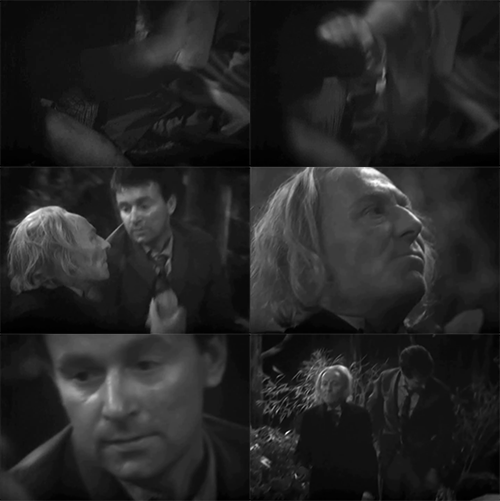
Doctor Who Season 1 - A Portrait in One Panel
It starts out with Team TARDIS being ambushed on the way back to the ship.  But it's kind of okay because they were planning on taking the wounded caveman back to the tribe anyway, much to the surprise of the one cavelady, who remarks that this new tribe treated them like a mother caring for a child. Still, no good deed goes unpunished in early 1960s Doctor Who and the four are tossed back into the Cave of Skulls - but this time, they aren't tied up (maybe that was the tribe’s idea of mercy, who knows?) Either as a last-ditch attempt to get the cavemen to let them go or out of sheer boredom (or both), Ian, Barbara and Susan work together to try to make fire.

I sort of feel like I need a peppy song about teamwork to go here.
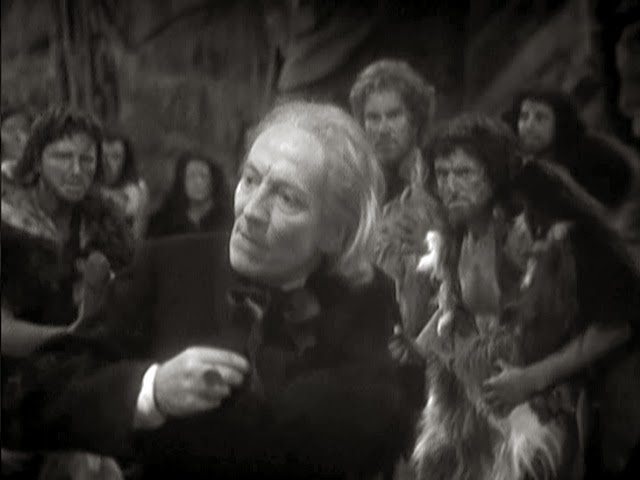
And here, we get another interesting scene that informs on future interactions within Team TARDIS. The would-be caveman leader comes into the cave and sees Ian trying to make fire the old-fashioned Scout Camp way with a couple of sticks, some string, and dead leaves. The caveman asks if Ian is the leader of their tribe and Ian defers to the Doctor. He doesn’t give a reason for doing that - maybe it’s because the Doctor is the owner of the TARDIS and he’s the seasoned time-traveler or it could simply be old-fashioned deference and respect to someone older. Either way, it’s kind of a nice moment, considering the relationship between the Doctor and Ian up to this point has been prickly at best.

(Again, I don’t have much to say about the cavemen because I don’t find them that interesting beyond giving Team TARDIS an obstacle to overcome. But I do have to wonder - when you’re cast as a caveman and you’re told you’re perfect for the part, do you feel insulted or complimented? I’m asking for a friend...)

Caveman discovering fire for the first time or your typical fifteen-year-old Boy Scout? Really, is there a difference?
Anyway - back to the story. Another part that I absolutely love is when Susan starts fiddling around with the fire and she sticks a skull on top of a burning torch. For one thing, she’s gotten over her fear of dead things (which is remarkable, considering there’s a recently-dead caveman in there with them). And here we have one of the best escape plans in the history of escape plans - which probably only works because we’re dealing with superstitious cavemen here, but that’s beside the point

*obligatory Hamlet joke*
Ian gets the idea to stick four skulls on torches and pretend like they all died from - what? Fire exposure? Falling into the firepit? Poking each other with flaming sticks? (I tell you - boredom!) Who knows, but all we've got is a prank and a prayer and let’s hope this thing works! Which it does, funnily enough (hey, we've only got five minutes to close out and get back to the TARDIS!) While the cavemen are scared spitless, Team TARDIS takes this chance to sneak out the front door and take off running through the forest (*cough* BBC crew brandishing palm fronds *cough, cough*). The cavemen come to their senses at the last minute and give chase, but it’s too late. Team TARDIS has made it back to the ship and they take off, not knowing exactly where they’re going but at least it’s away from the cavemen.

Last one to the TARDIS gets out first on the next hostile planet!
Which still isn't good enough for Ian and Barbara. While these four did unite in their ordeal with the cavemen, once they get back to the TARDIS it’s back to the whole “Get us back home!” conflict. This is going to strain at the dynamic between the Doctor, Ian and Barbara with Susan caught up in the middle. It makes for a fascinating character study, even though it’s not at the forefront of the main story until “The Edge of Destruction,” which is among my very favorite Classic Who stories. This conflict is something that I quite like in these early days, though I am glad that it gets resolved later-on.


By the end of “The Beginnings” boxset, this Team TARDIS settles into a really neat little family dynamic that makes this group an iconic (dare I use that overused term?) set and would carry Doctor Who into it’s first wave of intense popularity. Sure, the Daleks were there to keep the public interest coming, but without these wonderful and compelling characters, even the cool-factor of the Daleks wouldn’t have been able to keep things going. Doctor Who was off and running from the very beginning and this story set forth the template for fifty years of great storytelling and madcap adventure, changing lives and influencing so many kids and adults to look at their world in a whole new light.

Or, simply to give us all something to look forward to.

***
Thus, ends the Librarian in the TARDIS: Unearthly Revisited series - I hope you've all enjoyed it as much as I've enjoyed going in-depth on the story that started Doctor Who.  I mean, we talk about the Daleks and how that really kicked things into high gear - but you really need some great core characters for the weeks the Daleks aren't terrorizing the universe and I think this initial story really gave the show a good foundation to work from. You don't get to 50 years without a solid starting-point and "An Unearthly Child" (or "An Unearthly Child" plus "100,000 BC" - whatever you want to call it) laid the groundwork in spectacular fashion.  In the weeks following, viewers would get caught up in the Daleks and the historicals and so many other great characters and plotlines - but this is where it all started and this is what we're all celebrating.

***
Previously -
Part 3 - The Best Out of a Bad Situation

Wednesday, November 20, 2013

The Best Out of a Bad Situation

Title: The Forest of Fear
Written by: Anthony Coburn
Team TARDIS: First Doctor, Susan Foreman, Ian Chesterton, Barbara Wright
Adversary: Cavemen and a really scary forest
Originally Aired: December 7, 1963

(Note: Soooo... Tragical History Tour had a bit of a tragedy in that their photo hosting service went toes-up on them (at least, for the next 24 hours). Thus, I'm going to have to do without screencaps for this post. Yes, I could try to make my own... but no one really wants me to do that because they'd look horrible. We'll just have to make-do with some links to Tumblr).

My Review:

I left the review of “The Cave of Skulls” on a character development cliffhanger. Now, have you ever been scratching a dog’s tummy and all of a sudden the dog started thumping it’s hind legs, meaning that you’ve found the sweet spot and you’d better keep scratching there because, oh boy, that’s just right? (okay, maybe it’s just my dog that does that). That’s me when a story gives me some great characters with great development. That’s probably why I stuck with the First Doctor’s era so long when I was first getting into Classic Who. Lots of veteran fans tell you not to plow through Classic Who from the start because you’re going to get bored. Well, in my case, that was most certainly NOT true. It started in the previous episode, but it really ramps up in “The Forest of Fear.”

Now, I've always considered the four-part serial known as “An Unearthly Child” to really be two stories. The first episode is its own stand-alone plotline and the subsequent three episodes are another story arc. Which makes “The Forest of Fear” the second part in a trilogy. And, generally speaking, the second parts of trilogies are usually the weakest installment. The story neither begins, nor ends. It’s just there to (hopefully) move the story along until it can be concluded, but not to actually end. I can think of several book trilogies that this applies to - the second book in the Divergent trilogy by Veronica Roth is kind of a muddled, meandering mess and the second book of the Matched trilogy by Ally Condie sticks out like a sore thumb between two very good installments. Also, traditionally Classic Doctor Who has this thing where the second-to-last episode of a serial is more or less killing time until the final episode comes in to end the story and interest kind of lags a bit. So... “The Forest of Fear” already has the deck stacked against it.

That’s not to say it’s a terrible episode. It’s just not the best that we've been given up to this point. And that may say more about the quality of the first two episodes than it does about this one. Because there are still good things to say about it - but they’re a bit more subtle and require some retconning to make work. Luckily, I've spent quite a bit of time on Tumblr and this “headcanon” stuff is like oxygen (which is kind of hard to come by over there, what with all the breathless fannish-flailing. I regret nothing!)

Fear Makes Companions of Us All

When last we left Our Intrepid Heroes... they’d been captured, tied up, and tossed into the Cave of Skulls. Things look pretty bleak for Team TARDIS. So bleak, in fact, that this scrappy little group of time-travelers - thrown together by the most bizarre circumstances - actually start to work together to find way to get out of the situation they’re in. And this, dear friends, is where the famed Man of Action Ian Chesterton comes to the forefront. Ian’s skepticism and doubt has completely vanished at this point. There’s no point in trying to deny that this weird stuff is happening anymore - Here is a problem and he’s going to solve it by being the default leader of the group.

I talked in the last review about how Barbara was the one willing to accept time travel and Ian was the one who had to be convinced of the reality of the situation - really, he only gave it a chance when he saw how adamant Barbara was about it. In this episode, there’s a bit of a role reversal which I find completely fascinating. It’s not a straight-across-the- board sort of thing, but Barbara’s given into despair and panic and Ian’s the one who has to pull her out of it. Personally, I rather like that trade-off between the pair of them. They both have their strong moments and their weak moments, which makes them each such realistic and relatable characters. This episode is chock full of moments where Ian and Barbara are shown to be almost perfect foils to each other. Really, I can’t think of any of their stories where that doesn't happen at least once. Some of that is down to the writing (I remembering reading somewhere that early drafts of these scripts did include hints of a romantic subplot between Ian and Barbara - oh, hey, here it is!), but I think most of that is because William Russell and Jacqueline Hill have such awesome chemistry together. Their performances create such a unique relationship between these companions and it gives me chills every time I see it (someone said recently that Ian and Barbara are Classic Who’s version of Rory and Amy before they got married. Can’t say that I disagree).

(Not to mention providing Tumblr with some excellent out-of-context screencaps for all your shipping needs).*

Well, that fills the shipping quota for this review (pun very much intended) - what about the other half of Team TARDIS? At this point, Susan’s just sort of... there. Though I do have to say that, given how the Doctor is acting, Susan deserves some admiration for being as positive and cheerful as she is in this episode. Because the Doctor is a far cry from the “can-do” hero that I had come to know from New Series Doctor Who. Honestly - I really like that he’s a bit of a coward early-on in this incarnation. This takes some ret-conning, but when have Whovians ever been shy about that? The First Doctor has even said that he doesn’t like Earth or the 20th century - but his granddaughter loves it. The Doctor holds nothing but disdain and contempt for Ian and Barbara. And, honestly, Ian doesn’t think very much of the Doctor either. The only reason Ian just doesn’t take Barbara (and maybe Susan) and leave the Doctor behind is because the Doctor’s the only one who knows how to fly the TARDIS (well, Ian’s sense of honor and decency probably plays a part in not wanting to leave a frail old man behind for the cavemen to... do whatever it is the cavemen would have done). In the grand scheme of things, this does wonders for the Doctor’s characterization and growth.

Any Hope Is Better Than None

And then, we come to the famous “the Doctor almost brains a caveman with a rock scene.” Which, I totally missed that on first viewing. After Team TARDIS has been fleeing through the eponymous Forest of Fear for the past ten minutes, the caveman-leader-dude and his ladyfriend - who have been pursuing Team TARDIS at this point - get attacked by some ferocious creature (totally off-screen because I highly doubt any kind of zoo animal was in the BBC budget at the time). After much screaming and an implied bloodbath, the caveman is seriously injured - and Team TARDIS can get away! Except... Barbara feels bad about leaving the poor caveman to die and she goes to try to help. Recognizing that this would be the right thing to do, Ian and Susan follow suit. And the Doctor... picks up a rock and decides that he is going kill their would-be attacker because that means they’ll get out of there quicker.

(Never let it be said that the Doctor was one to follow the crowd).

But the Doctor doesn't get the chance to follow through with his plans because Ian stops him almost as soon as the Doctor picks up the rock. And it’s just such a fast moment, but the Doctor is lost for words - almost for the first time since we've met him. And it’s more than just this one little plan has been foiled or that he’s cross that he hasn't gotten his way (as Susan says) - but I think this moment is when the Doctor starts to think that maybe humans aren't so beneath him as he once thought. He sees how Ian and Barbara are concerned over the injured caveman, how they clean him up and work to take him back to the safety of his tribe, even though it may mean they get captured again. And the only reason I think that this starts to change the Doctor is because that’s the kind of quality that I saw in the Doctor’s later lives. He doesn't seek to kill anyone and he doesn't look for violence or trouble. Obviously, something happened to change him and all that started with Ian and Barbara showing kindness and compassion to an adversary. If nothing else, that’s what “The Forest of Skulls” should be remembered for - the tiniest moment that started the Doctor on his path toward being better than he started out being.

Certainly, the Doctor’s character development goes on over the course of a very long time and we don’t actively see it played out on screen (beyond noticing differences in how William Hartnell plays the Doctor as time goes on - but you actually have to be paying attention to it because the change is so subtle). There’s a lot of reading-between-the-lines involved, but that’s something I totally enjoy and love, which is why I adore the First Doctor’s era so much. I've said this before with Classic Who (and I’m certain to say it many more times), but there is tons and tons of depth to these stories and so many people fixate on the effects or the low-budgets or the fact that these were filmed “as-live” or even that they’re in black and white and never see beyond those ticky-tack, nit-picky things to find the delicious meaty chunks of plot and story and character. And that’s totally unfair to these stories - but then again, that leaves more for me to enjoy. So - there!

***
*All joking about screencaps aside, Katie and Claire of Unwilling Adventurer actually go out of their way to provide context and analysis in everything related to the First Doctor's era. They're the best fan-create resource on the Hartnell era that I've ever seen online and I highly recommend their most excellent Tumblr.  As a bonus - here's their analysis of "An Unearthly Child" that they posted on the anniversary last year.  But don't think they never have their fangirl-flaily moments - oh, boy do they ever fangirl! :)

***
Next Time, on Librarian in the TARDIS: Unearthly Revisited
Part 4 - This story is ending, but the adventure never ends!

Previously -
Part 2 - Baptism By Fire

Tuesday, November 19, 2013

Baptism By Fire

Librarian in the TARDIS - Unearthly Revisited, Part 2

Title: The Cave of Skulls
Written by: Anthony Coburn
Team TARDIS: First Doctor, Susan Foreman, Ian Chesterton, Barbara Wright
Adversary: Kal and the Cavemen (sounds like an 80s punk-rock band, doesn’t it?)
Originally Aired: November 30, 1963

Synopsis (basically the same as yesterday)

Again - screencaps from Tragical History Tour

My Review:


"The Cave of Skulls" is really a story of two halves. There's the wrap-up of what was left over from "An Unearthly Child" - convincing the audience that, yup, we've time-traveled. And then… there's the caveman storyline. Which, I'm going to freely admit, I've never been that invested in. As far as I'm concerned, the cavemen serve only two purposes: (1) To prove that the TARDIS can travel in time (see also: "The End of the World") and (2) to create drama and conflict for the four main characters to interact with. The whole thing with making fire - eh, not that important. At least, not in and of itself. Mostly it’s there just to make Team TARDIS look good on their very first outing.  Which makes sense, when you have this core group of the Doctor, Susan, Ian and Barbara that you're going to be following throughout this series, you want the audience to connect with them.  You're not terribly concerned about these periphery characters that are just there to propel the story onward.

But that doesn't mean there’s nothing here to love. Most of fandom may just skip over these three episodes, but I've got plenty to say about them. So, let’s get going!

A New World For You


The Gallifreyans: Just another day at the office. The humans: ...the hell??
Once the cavemen characters have been established, the story cuts back to the TARDIS. Ian and Barbara are slowly coming back to consciousness from their first trip through the time vortex, and the Doctor and Susan are at the console, blissfully pretending that nothing out of the ordinary has happened. From this very first shot, you can tell that this isn't the first time the Doctor and Susan have done this. The image is very much that of Captain Kirk and his crew on the bridge of the Enterprise or even Han Solo and Chewbacca piloting the Millennium Falcon. Just another trip through time and another day to check the instruments. I seriously love that sight of complete normalcy on the part of the Doctor and Susan, but Ian and Barbara are in the background helping each other up with looks on their faces of "What the hell just happened?" It's one of my absolute favorite things about this serial!

I have no reason to include this picture other than I like it.
Now, through the last review, I often referred to Ian and Barbara together. They work together, they came to the junkyard together, they were kidnapped by the Doctor together. They're fantastic individual characters, but I love their interactions together. That being said, I love how this first scene establishes that there are times when they are such very different people. No where does this happen better that when the Doctor and Susan are trying to convince Ian and Barbara that they're not in 1963 London anymore. Barbara believes them a lot quicker than Ian does. There's even a sense that Barbara is eager to get out of the TARDIS and see things for herself. Ian… not so much. He's actually more argumentative about it - vehemently insisting that this has all been a trick and there's no way they could possibly be anywhere except the junkyard (or maybe he's a bit worried about leaving his car parked out on the street for who knows how long - that's just me reading between the lines). You really can't blame him at all - Ian's a scientist. He's made his life around experiments and scientific proof and what he can see in front of him. He doesn't trust anything he can't see, hear, or touch, so it's no wonder that he doesn't believe what the Doctor is telling him until he's actually outside the TARDIS doors - but he's also reluctant to go there. At least, until Barbara asks him if he's coming.

Remember how I said I wasn't going to fangirl-squee over Ian and Barbara anymore? You know I was lying, right?
(Side Note: Something I never noticed when I've watched this before is when the TARDIS doors open out into the wilderness, the Doctor takes off his hat. Maybe I'm reading too much into this, but he almost does it out of respect and reverence - as if William Hartnell did it on purpose to mark the historic moment when the TARDIS opened up onto an alien landscape for the very first time. Or maybe his head was itchy. Who knows?)

Disguising Itself Wherever It Goes

Nope. Definitely not Shoreditch anymore...
And here we get another brilliant piece of Doctor Who mythos - the TARDIS Police Box. That little moment when the Doctor first sees that the TARDIS hasn't changed and he's mumbling "how disturbing" it is, that used to bother me. Like William Hartnell wasn't quite putting his all into those lines. But then I thought about it some more and it makes more sense. Up until now, the Doctor has been the epitome of confidence in his time-and-space ship. Confident to the point of condescension, especially when he's dismissing Ian's protests that none of this can be possible. But then something goes wrong, and suddenly the Doctor's been wrong-footed. Suddenly, he isn't the smartest person in the room. He doesn't know why the TARDIS hasn't changed, but he doesn't want to admit that he might not be totally in control of the situation. So, he's going to run off and look for rocks or plants or whatever.


It falls to Susan to provide explanation. And seeing as how the Doctor's off… wherever... and Ian's still wondering "What the hell just happened?", Barbara is the one who's more keen on the newness of everything she's seeing. For reasons that aren't as easily explained as Ian's scientific skepticism, Barbara just soaking up this experience. She doesn't have a rational explanation, but she's more willing to go with it. She even admits that she doesn't really know why - she just believes that this is what's happening. So, it's fitting that Barbara is the one that figures out that the TARDIS is supposed to disguise itself wherever it goes. And, she actually sounds impressed by it. That one line is just so Barbara - she's rational and intelligent, but willing to accept new things that's she's presented with and add them to her ever-growing knowledge of the universe. It's something that I totally love about her character - and it makes her a perfect foil to Ian. In fact, that's probably the point when Ian starts to accept everything that's happened - he probably wouldn't have if Barbara wasn't willing to roll with it all.


Fire Will Kill Us All

I said that I wasn't too into the caveman storyline, and I'm really not. But I do have to talk about the end fight scene. Actually - before that. When the cavemen bring in the Doctor and the Doctor's laying unconscious on the rock, it's only when the Doctor wakes up that the scene gets interesting. Coming from New Who, I have no problems believing that this incarnation of the Doctor is still so very young and inexperienced. It's one thing to show off your shiny, futuristic toys to confuse people. But get him away from the TARDIS and all of his equipment - there's not much to him other than bluster. This is a Doctor early-on in his travels and he hasn't quite mastered the art of Social Interaction (compare this to later stories like "The Reign of Terror" when he convinces the jailer at Conciegerie Prison that he's some government official - well, a fluffy hat will do that). I know I'm coming at this backwards and a 1963 audience wouldn't have had that interpretation, but it's still something of note.

Caveman Negotiation 101 clearly wasn't covered at the Time Lord Academy.
Then, the cavalry arrives! For all the talk that Ian is the action hero (and he is, don't get me wrong!), it's interesting that Susan is the first one to jump one of the cavemen threatening her grandfather. Since realizing her grandfather was missing, Susan's been pretty much in a blind panic. I don't know how her travels with her grandfather have been up to this point, but I get the impression that she hasn't been separated from him very much, if at all. Plus, we're not sure of the circumstances of how they left their home planet. In many ways, Susan is probably a very lonely girl. I don't mind that she screams and panics a lot - many fans kind of dismiss her as just a screamer. But given everything that's implied to have happened to her (admittedly we don't know much - though I do know Big Finish has had some fun with pre-Unearthly Child stories), I really don't mind that she gets scared easily. In fact, I would be worried if she didn't get scared.

So, Team TARDIS gets captured by a bunch of irate cavemen who just want some fire (remember how Ian didn't have matches in the last episode? Boy, oh, boy he probably really wishes he had some now) and… what's this? The Doctor apologizes for getting all them into this mess? The condescending jerk that kidnapped Ian and Barbara and took them thousands of years into the past so they could get tied up and tossed into some smelly, disgusting cave?

Would you two on the left stop being all adorable and crap?? It makes it my job even more difficult!
That, my friends, is called character development. And there'll be more of it in the next episode!

***
Next Time, on Librarian in the TARDIS: Unearthly Revisited -
Part 3 - In which there is an enormous amount of running involved.

Previously -
Part 1 - All There in the Manual

Monday, November 18, 2013

All There in the Manual

Librarian in the TARDIS - Unearthly Revisited, Part 1

Title: An Unearthly Child
Written by: Anthony Coburn
Team TARDIS: First Doctor, Susan Foreman, Ian Chesterton (joins), Barbara Wright (joins)
Adversary: There really isn't one! (not for the first episode, at least)
Originally Aired: November 23, 1963

Synopsis (from TARDIS Wikia) -
Susan Foreman is a mystery to teachers Ian Chesterton and Barbara Wright, seemingly knowing more than she should about the past... and the future. Their curiosity leads them to follow her home one night, only to find that her 'home' appears to be a deserted junkyard. In the junkyard, they discover a police telephone box and a strange old man, who claims to be Susan's grandfather, and calls himself the Doctor. The journey of a lifetime is about to begin...

My Review:

I'm baaaaaack!

While my 50th Anniversary reviews of Librarian in the TARDIS are complete, the Doctor Who 50th Anniversary celebrations are far from over. This Saturday is The Day of All Days and what other fitting tribute would there be than to revisit the story that kicked off this fantastic story of a strange old alien and his time-traveling police box?

I thought about reviewing “An Unearthly Child” all together as it’s own little Bonus Review, but the more I thought and wrote about it (just from memory - I hadn't watched it for a while), I realized that every episode is packed with so much detail and nuance and I didn't want to miss anything good. And I’ll probably get other chances to discuss and dissect this story (and others like it), but the thoughts I had felt right for the 50th. So, without further ado - let’s get started with Episode 1!


(Screencaps from Tragical History Tour)

A Mild Curiosity in the Junkyard

I came to Classic Who in an interesting way. I mainlined New Who in a little over a month, watched the Paul McGann TV Movie, then found a copy of “The Five Doctors” on YouTube that incorporated elements from New Series (and probably gave a fanboys a fair number of heart attacks, now that I think about it). After the glorious sampler plate of “The Five Doctors,” I wanted to dive into Classic Who headfirst. Problem was, I wasn't sure how to begin. I knew there were any number of points I could start with, but honestly - I was intrigued by Susan. I didn't know much about her, other than she was the Doctor’s granddaughter and how cool would it be to get some of the Doctor’s personal background? (how precious was I?) I took the same attitude I did with New Who (and that I do with any new show that I start watching), that I really ought to start from the beginning so I can get all of the background and have a good foundation for these characters and stories. I don’t like missing out on inside jokes and references, quite honestly.

So, First Doctor it was. I located a copy of “An Unearthly Child” (*cough*) online and went to town.

Well - I first went to the junkyard.

One wonders how close this guy came to being the Doctor's first human companion.
The initial opening shots of the junkyard (complete with the police officer that recently became the longest-running character in the show, thanks to a certain little tribute trailer) are, quite simply, a brilliant choice for starting things going. Director Waris Hussein deserves all kinds of praise for this because it would have been so easy to start with the ordinary, everyday scenes of Coal Hill School and then ramp-up to the fantastical revelation of the TARDIS. But starting with the little tour of the junkyard (with the theme tune still playing hauntingly in the background) sets up for the audience that all is not normal in this sleepy little corner of London. There is a mystery to be solved and we the audience are clued in on it right from the beginning. This is not going to be a typical educational show for kids - this is going to be spooky and intriguing and FUN! And, even though I knew it must be coming, I got a real thrill out of seeing the police box through the fog and that strange, tell-tale humming just beneath the surface.


Now that I think of it - why a junkyard? The TARDIS had camouflaged itself as a Police Box - it could have easily been set out on the street corner, right? But the junkyard is another brilliant choice - either by the director or the writer, I really don’t know who it was but they were genius for doing that (I wonder if anyone’s ever asked that question). Junkyards have their own creepy atmosphere - it’s a place where no one ever goes, full of things that nobody wants anymore. It could be dangerous to go inside, even. It’s like putting the Wardrobe to Narnia in the Spare Room that no one uses - it’s a place that is unclaimed, unused, unorganized. Anything could happen (and it probably will).

Phew - two whole paragraphs on the first minute of screen time! Boy, I’m glad I split this thing up!

“Thank You For The ‘We’”


Now that the mystery and atmosphere of the show has been sufficiently set up, it’s time to bring in the mundane and ordinary - a tried and true formula that has been a storytelling staple for Doctor Who for 50 years. Coal Hill School. Just your average, run-of-the-mill secondary school with a bunch of average, run-of-the-mill students racing to get out of the building as the final bell rings before their average, run-of-the-mill teachers give them more homework or get after them for running in the hallways. Average. Run-of-the-mill. Nothing to write home about. Nothing at all.

Now, when I hit “play” on “An Unearthly Child,” I had no idea that the Doctor had ever traveled with more than one companion at a time. Well, that’s not entirely true - I’d been floored when I saw “The Five Doctors” and saw that the Doctor was accompanied by (what I thought he was at the time) a redheaded guy who probably worked in investment banking (that would have been Turlough. Seriously - I was completely clueless). So, I was more than a little surprised when the story didn't start with Susan, as I expected, but with her teachers.

To be perfectly, 100% honest, I had never even heard of Barbara Wright or Ian Chesterton. Which is really weird to me now because I’d known about Sarah Jane Smith and I’d heard of Tegan and Nyssa and Peri and Ace and the Brigadier and Jamie and Susan, but the Doctor’s first human companions were a complete surprise to me. Looking back, I like that Ian and Barbara were a surprise to me - probably because I was going into Classic Who thinking that I knew all the backstory the show had to offer and there was no way that I could be surprised in any major way (in my defense - I was still so very new at this and I didn't have any veteran Whovian standing by the guide me in this).

This will be the only time I fangirl-squee over these two this entire week. Seriously. The ONLY time.
(Yeah, you know I'm lying).
But what I totally love about these initial scenes with Ian and Barbara is how fast I went from “Who in the world are these two?” to “Holy crap! They’re amazing!” And really, they haven’t even done much - just expressed concern over a student that they've both had problems with. But you do get the sense that, while they’re both very set in their ordinary lives, they also have a lot of potential to be absolutely magnificent. It’s much the same with Rose Tyler when the series came back. And this isn't the first time (as I’ll point out here in a bit) that Russell T Davies took cues from the Classic Series when he was crafting New Who. Ordinary people with ordinary lives on the brink of an extraordinary adventure.


Something else that I hadn't clued into until much later, but that I really love, is that from the get-go Ian and Barbara have a really strong relationship with each other. Whether you “ship” them romantically (as I do) or if you just think they’re good friends, there is an unmistakable bond between these two that carries the first few stories (and, arguably, much of the first season) and that bond immediately creates a bridge between the story and the audience.

I know I’m getting ahead of myself here, but there are moments when the Doctor is being downright unpleasant and unlikeable that it’s really jarring (especially if you’re coming from New Who). But then Ian and Barbara say something to each other about it you’re back on board with the story.  For myself, it was reassuring that I was still watching the same show that I'd fallen in love with - there was an unspoken promise that this irascible old man would most certainly become the character that I knew and adored, I just had to give him time to get there. And really, that’s what kept me watching throughout these four episodes - I was still getting used to the different format coming from New Series Doctor Who and I hadn’t quite gotten my feet under me (so to speak). But I had Ian and Barbara to connect me to the rest of the story and as long as they were doing awesome things (which is pretty much all the time), I fell right in with everything else. They’re two of the absolute best companions ever in Doctor Who - and I’d even argue the foundations for these two characters are the basis for all future companions.

“What Are You Doing Here?”

So, Ian and Barbara go poking around in the junkyard looking for Susan (no way she could possibly be in that old police box... that's humming?) And - eleven minutes into the first episode - the title character arrives, waving his scarf around to clear the dust and examining all the junk lying around the place. Ian and Barbara (rather politely) ask this mysterious old man if he’s seen a young girl and the old man completely blows them off. It’s obvious the Doctor is hiding something - and Susan doesn't make it easy for him to keep his secret hidden, still calling out to her grandfather from... somewhere?


William Hartnell’s first appearance as the Doctor sets the tone for his character beautifully - indeed, it sets the tone for how the Doctor is going to treat Ian and Barbara, at least for the foreseeable future - but it also gives him room for character development. They’re bothering him. They’re in the way. They’re going to expose his closely-guarded secrets. Still, underneath all that bravado and bluster lies the beginnings of a spark of that very first Team TARDIS. Even before their characters truly know each other (as far as the story’s concerned), William Hartnell, William Russell and Jacqueline Hill positively sparkle in this first scene together and you just know that this is the start of an amazing team (well, I was excited about it, anyway).

The start of a beautiful friendship (eventually...)
A Thing That Looks Like a Police Box

One of the coolest things about the Doctor Who’s revival in 2005 is how much stuff Russell T Davies not so much “borrowed” as outright stole from “An Unearthly Child” when he wrote “Rose.” Both episodes start out with the Doctor’s soon-to-be companions in their normal, everyday lives. Both progress as the result of these normal, everyday lives being disrupted by the smallest weirdnesses. And both introduced the inside of the TARDIS - not in this grand, upscale camera shot, but by the companion’s initial reaction. The audience saw Barbara’s face before we saw the inside of the TARDIS and the same thing would happen with Rose 42 years later. It’s a genius move to create a sense of wonder in the audience, by first creating a sense of wonder in the characters we've already connected with (Hey, don’t fix what ain’t broke!)

Audiences and companions' first entrances into the TARDIS, from 2005 and 1963
And here comes The Exposition! In general, exposition can be really boring if not handled well, but for setting up the whys and wherefores of how this new science fiction program will operate - I have a damn hard time imagining that Verity Lambert and company didn't set up the entire Doctor Who mythos right from the very beginning. Even though I've heard stories about how most everything was done on the fly and by sheer luck and coincidence, the story is told with such utter confidence in everything that’s going on, you absolutely believe that there is already a plan to reveal the Doctor and Susan’s home planet and the circumstances of their exile. Sure, they don’t outright mention Gallifrey or Time Lords or regeneration (and those things wouldn't even be invented until years later), but coming from New Who, I feel like there’s a certain amount of mystery to be explained later. Indeed, there’s an unspoken promise that it will be explained later, but right now we've got the universe to explore!

Not exactly an average Parent-Teacher Conference, is it?
Here’s kind of an odd example of what I’m talking about - I've recently gotten into the show Person of Interest. Over the show’s first season, most of what we learned of the reclusive-yet-lovable genius billionaire Harold Finch was directly tied into the background of the Machine he built for the government that spies on people. We learned very little about his personal life that wasn't related to that project. But in Season 2, we do get more of his backstory that we knew must be there, but it was never a point of discussion in Season 1 because there were other things going on that directly related to the premise of the show.

The Doctor is very much a Harold Finch-type character - reclusive, eccentric, standoffish at first, but just a big squishy teddy bear once you come to know him. We know he’s protective of his granddaughter (and rightfully so - we don’t know the nature of the Doctor and Susan’s exile, but we know enough that the situation is dangerous for them both).


I've really got to talk about Susan here. Because what makes this Team TARDIS work is the connection that Susan has to her grandfather, but also the connection she has to 20th century Earth and, by extension, her schoolteachers. While the Doctor insists that he merely “tolerate[s] this century but [doesn't] enjoy it” in this first episode, Susan has already fallen in love with this planet, its customs and people. I have no doubt that love eventually inspires the Doctor to adopt Earth as his second home planet. There are other reasons that come later (in these reviews, in fact!) that the Doctor would start to soften his attitudes about Earth, but it wouldn't have happened at all if it wasn't for the innocent and sincere curiosity that Susan exhibited from the outset. Susan’s heart and tenacity make her a very unique companion - these qualities don’t get exhibited much in other companions (I think you could make a case that Jamie is that way - possibly even Rose, in some ways) and that really endears her to me. Here’s a young girl whose was obviously very close to her grandfather. She’s got his same desire to explore new worlds and she gladly tagged along for the ride when he ran away from Gallifrey. She enrolled in a primitive school on a primitive world in order to more fully understand the people of this planet - which, that has courage written all over it. And she doesn't shy away from a challenge. Sure, she’ll have moments where she’s scared out of her wits - who doesn't? But you have to admire a girl for trying new things!

Wanderers in the Fourth Dimension

And here’s the moment of truth. Ian and Barbara try to leave the TARDIS, but the Doctor locks the doors and takes off with them still inside - looking positively horrified at what could possibly happen next. Not much is said after the TARDIS takes off - there’s an extended sound effect of the TARDIS taking off, Ian and Barbara are knocked unconscious (because of the stress of first-time time traveling? Heck, I don’t know - it never happens again), scenes of London fall away as the ship rockets off into space and time...


...and comes to a stop on a desolate, rocky plain with a menacing shadow stretching across the landscape. The credits roll and the theme tune plays. Jaws are picked up off living room floors across the UK. For the second time in two days, history has just been made. This time it’s not an assassination an ocean away, but one scrappy little family tea-time program that’s going to be the talk of the town - a program that won’t soon be forgotten.

(Okay, I’m just imagining how things would have been for the average television viewer in the UK in November 1963 - but it’s as good as anything else, right?)

We're not in Shoreditch anymore...
There’s just so much packed into this one little 22-minute episode that I could have gone on and on about characters and story and plot elements. The writing is tight and engaging, there’s just enough mystery left to keep you excited for the next part - which will be the topic tomorrow. While “An Unearthly Child” has the reputation of being a stellar piece of television and the succeeding three episodes... not so much, I’m certain I can find something compelling to talk about in each one. Hell, it was good enough for the audiences to stick around before the Daleks finally showed up.

(Aw man... I wanna go watch this episode again!)

***
Next Time, on Librarian in the TARDIS: Unearthly Revisited -
Part 2 - Caveman politics - bah! Let's talk character development!

Monday, April 22, 2013

Recycled Christie Cardboard IN SPACE!! (tastes like recycled cardboard too)

Librarian in the TARDIS, Review 1.03 


Title: Ten Little Aliens
Author: Steven Cole
Team TARDIS: First Doctor, Ben, Polly
Adversary: The Ten-Strong
Original Release Date: June 2002
Range and Number: Past Doctor Adventures #54

Synopsis (from Goodreads) -
Deep in the heart of a hollowed-out moon the First Doctor finds a chilling secret: ten alien corpses, frozen in time at the moment of their death. They are the empire's most wanted terrorists, and their discovery could end a war devastating the galaxy. But is the same force that killed them still lurking in the dark? And what are its plans for the people of Earth?

My Review:
So far, I've enjoyed this blogging project.  In the interest of full disclosure - I went ahead a little bit and already have the first two posts for the Second Doctor's era written up and ready to go (minus a little bit of copy editing and formatting) and I'm halfway through listening to the audio adventure I selected for the Third Doctor.  Seeking out the lesser-attended-to Doctor Who stories has been a treat and a joy and I can't wait to share my thoughts on those stories with my loyal readers (all seven of you).

In my real-life, big-kid career, I am a librarian (as evidenced by the title of this blogging project - thank you Captain Obvious).  It is part of my job to read as many books as time permits and evaluate them on certain criteria.  To be truthful, I'm a little more aggressive in my book reviewing habits.  It just comes with the territory.  I have so many to read and if I start something I don't like, I have no problem with putting it aside and going on to something else.  In a few cases, I almost take offense to a book that I don't like.  It's weird, but I'm almost like "How dare you be so horrible and waste my time!" (completely bizarre, I know).  Whereas with my TV, movie, and audio story reviewing, I am much more in fangirl-flail mode because... actually, I don't know if there is a "because" for that stuff.  I do get into some nitty-gritty in terms of story and characters - just probably not as deeply as I do with the printed word.  I guess it's because I actually have to pay attention to books because I'm probably going to have to tell somebody about this at some point and it would be nice to be able to at least act like I know what I'm talking about.  

When I decided to include novels in my review project, it was mostly so I would finally force myself to sit down and choose some Doctor Who books to read.  I've enjoyed the books based on New Who that I've read (even "The Story of Martha" - it wasn't that bad.  Someone just needs to come along and finish it, that's all).  But I hadn't read any books based around the Classic Doctors and I thought that was a crying shame.  But between Target Novelizations and Past Doctor Adventures and Eighth Doctor Adventures and New Adventures and who-knows-what-else is out there - it's hard to know where to start off with it.  Rather than randomly draw book titles out of a hat and try to track down a bunch of stuff that, in all likelihood, is out of print, I decided I would read the 50th Anniversary reprints that I was probably going to buy anyway and call it good.  These stories were specifically chosen for this commemorative year, so they all should be pretty decent, right?

Well... not exactly.  And it pains me that it's the first one I tackled that I absolutely did not care for.

The first thing that really got my hackles up was how long it took for Team TARDIS to show up.  The first chapter or so (and these are long chapters) was focused on these ten... soldiers? Explorers? Miners? (Ben called them "Space Marines" at one point, which was a good a description as any for what I had to work with). I never got the feel for them.  And they are all pretty much cardboard copies of each other.  There is very little to distinguish one of these characters from another.  I don't even know whether they're male or female since they all refer to each other by their last names.  The most character description I got was a list of records that look like they came from some sort of personnel file.  This list was partway through chapter two (I think) and included physical descriptions, rank and experience of each character.  But something was included at the end of each record and the way this was present grated on my nerves - the last question looks like it was posed to the person whose file this was.  The question was something along the lines of "What do you think of the Shirr?" (the Shirr being the aliens on this planet/moon/asteroid/thing/I-don't-even-care-anymore).  And every single question was answered pretty much the same way - "the Shirr are evil, sub-human, deadly creatures that don't deserve to live." Granted, there was some variation in the wording of these answers in an attempt at giving these people personality, but already I just don't give a flying squirrel in a coconut tree about them.  Not a great introduction to the characters that are supposed to be the one-off supporting cast that makes the Doctor and his companions look good.

By the time we get a scene with Team TARDIS - this time, with the rather interesting combination of the First Doctor, Ben and Polly - I am begging for characters in this story that I can latch onto and love.  Luckily, I've recently been discovering some of Ben and Polly's stories for the first time and they are quite the lovely pair (and I gladly bring out the shipping goggles for this and no, there is no shame).  Sadly, the very first scene with Team TARDIS is woefully short (but oh so welcome) and we're back to The Land of Tough-Guy Cardboard Cutouts.  This whole thing reminded me of the time I tried to watch Battlestar Galactica and I just couldn't be bothered to care about any of those snarky, cynical, overly-dramatic bastards.  Truly, I wanted to go back and read more about Polly’s daffodil-yellow spacesuit because that sounds lovely (probably wouldn't look so lovely, but anything can be good if left to the imagination).

One of the biggest challenges with writing Doctor Who is that - apart from the central Team TARDIS - your cast of characters changes with each story.  Oh, there are some that have some reusability (Jack Harkness, River Song, Winston Churchill, Dorium Maldovar - and here I realize those are all Steven Moffat creations or at least from the Moffat era of Who), but for the most part you have to create a whole new cast of characters for the Doctor and company to interact with.  And you also have to present them in such a way that the audience cares about them too - whether they become the Doctor’s allies or if they are up to no good.  Sometimes this works (I’m still hoping for a reappearance of Liz X) and sometimes it doesn’t (the entire Ganger crew can be safely locked in the cupboard somewhere and completely forgotten about).

Further into the book (say, about chapter ten) things start to get interesting.  Stone statues reminiscent of Weeping Angels begin terrorizing the group (they actually are referred to as angels).  Polly and Ben wonder why they don’t just get into the TARDIS and leave - which is a fun little nugget to have the companions wonder, since fans have been wondering that off and on for years (Answer: Because then there wouldn’t be a story. Duh).

When the military crew start disappearing/dying, that’s when the characterization starts taking hold.  They aren’t the cardboard cutouts that we started out with, but they've only upgraded to colorful posterboard. Marshal Haunt, for example, has a whole backstory that we only get when she’s on her deathbed - except she didn't really die, but I didn't realize that until much later when she's suddenly barking orders at somebody and I'm thrown for a complete and utter loop on that one. Frog gets some character development - and the rest of the crew drop their tough-guy demeanors and starts to be a bit more... sympathetic, maybe?  Still not enough to make me like them at all - it’s a matter of “Too Little, Too Late.”

The Doctor isn’t given enough “screen time” (as it were) to have much of an impact for me. He comes in now and again to remind the reader that he’s still there and this is still a Doctor Who story (sort of like the early William Hartnell years).  This bugs me a great deal and I’ll tell you why - by the time Ben and Polly have joined Team TARDIS, the First Doctor is a more proactive presence in the TV stories (ironic since this is supposed to be around the time Hartnell’s health was starting to fail).  Had his companions been Ian, Barbara and Susan (or even Vicki) in this story, I would have justified his limited presence in the story because those companions tended to get a larger piece of the action.  Quite frankly, the Doctor was a bit of a coward early on.  But something happens to the Doctor somewhere around “The Time Meddler” and he starts becoming more like the heroic and curious Doctor that we’re familiar with today. So, to have him be this detached and irascible and, quite frankly, absent character in a story that’s supposed to be set close to his regeneration into Patrick Troughton... yeah, it’s a little off-putting.

(Listen to “The Smugglers” or watch “The War Machines” - you’ll know what I’m talking about).

Thank goodness for Ben and Polly because they save this story from being complete crap and helped me limp through to the end.  They bring some humanity into the situation when the soldiers are either being all “RAWR! Let’s kill the alien bastards!” or “OH NOES the aliens infected me and now I have to crawl in a hole and die! *emo-angst*” (seriously - can we get ANY kind of balance with these people?)  But Ben and Polly are there to give the reader at least two characters that don't read like military stereotypes in a James Cameron film.  They both want to get out of this situation and are doing everything they can to solve this mystery.  Just like any tried-and-true companions of the Doctor would do.  It's sort of like when you watch a Doctor Who episode and you can tell the one-off cast just isn't clicking and it seems like some don't even want to be there, but the Doctor and the companions are giving it all they've got (this happens a lot in Classic Who - especially in the 1980s, which is a decade of Who that I have a lot of affection for).  It seems a lot like literary!Ben and literary!Polly are giving it every last effort they can muster, but these other people can't be bothered - just give them their paychecks and let them go.

Around chapter 13 is where I was starting to think this story was going to pull itself out of the mire and make something of itself.  There were some nuggets of character-development going on, the plot was thickening, the Doctor was allowed to have a presence and figure things out, Ben and Polly were carrying the action and carrying it well.  I thought "Oh good, I can finish this - no problem."  (Also - the First Doctor is given a line very reminiscent of “reverse the polarity.”  The exact line is “A simple matter of reversing certain polarities.”  It was a nice little call-forward that I really liked.  So there is that for you).

And then... the story became "Choose Your Own Adventure."  And it was at this point that I went "OH HELL NO!!"

I am NOT a fan of CYOA - I'm just not.  If I knew that was coming, I would have chosen another First Doctor story to review.  I hate it that much.  CYOA stuff always annoyed me because I don’t like jumping around a book as I’m reading it.  It was never a favorite of mine and here you’ve thrown it right in the middle of a perfectly straightforward (albeit confusing as hell) linear narrative.  If it wasn’t for the fact I’d promised to read all of these in their entirety for this project, I’d have said “Screw this!” and gone on to “Dreams of Empire.”  It was that off-putting.

I’m hoping that this is all a product of this being the first book from the Past Doctor Adventures line I’ve read and I need to get used to the way these stories are structured and told.  I’ve read books based on New Who and enjoyed them to varying degrees - never outright hating any, though. Just some are better than others - sort of like how I deal with my Who in general (which I have discussed from time to time on this blog).  I'm sure there are books in the this line that are good - I just need to find them.

Bottom Line: I’ve heard mixed opinions on the New Adventures novels - some people love the books and some people hate them and some people don’t care either way.  So far, I’m not terribly impressed.  I hate to be a Debbie Downer because there is very little Doctor Who that draws my ire, but this one did it.  This story was a disappointment.  Not even the wonderful combination of Ben and Polly could save this one, even though they tried.  And that’s too bad. I want to love these stories because they were specifically chosen for this special commemorative line of books and I kind of figured The Powers That Be would choose quality stories - but they failed miserably with this one (hey, if I don’t like something, I’m not going to pretend that I did).  I might even have to put this down to the levels of “Love and Monsters” bad because - ugh. No. Just... no.

And the Agatha Christie references in the book and chapter titles made zero sense.  That's all you need to know about that.

(Geez, that was a horrible start to the novels I'm reviewing.  Please, please, please let "Dreams of Empire" be better!")

***
Next Time on Librarian in the TARDIS -

Previously -

Friday, April 12, 2013

I Think It's Gonna Be a Long, Long Time

Librarian in the TARDIS, Review 1.02

Title: The Rocket Men
Written by: John Dorney
Team TARDIS: First Doctor, Ian (narrates), Barbara, Vicki
Adversaries: Ashman, the Rocket Men
Release Date: August 2011
Range and Number: Companion Chronicles 6.02

Okay, Whovian boys and girls - I have a teeny-tiny confession to make.

I am a shipper.

I know, I know - you're thinking of those 15-year-old girls on Tumblr photoshopping Ten and Rose into all sorts of, shall we say, compromising positions or poorly-written slash-fic about Captain Jack, Sabalom Glitz and a mango (don't ask me how I know of these things - it scares me too).  But I come from a more sweeter brand of shipper.  The kind that appreciates a sprinkling of warm-fuzzies living harmonious alongside the requisite "Yeah, man! Let's blow crap up!" in her speculative fiction.  Admittedly, some people don't.  Their reaction is "Feelings are icky!"  That is perfectly fine.  But that doesn't stop me from going "Awwww..." when two characters share A Moment, no matter how brief.

That being said - is there anyone out there doubting that Ian and Barbara are an Item?  It may not be exactly canon, but it's darn near to it*.  I figured it out somewhere between "The Reign of Terror" and "Planet of Giants" (Sue beat me by four stories - she figured it out in "The Keys of Marinus," so more power to her).  While I have many reasons why I enjoyed "The Rocket Men," the exploration of Ian and Barbara's relationship may be my number one reason why I liked this story so much.

(I think I just scared away all the fanboys *evil cackle*)

Anyway - I’m getting off-subject here (I listen to Traveling the Vortex. They tangent. A lot. It rubs off on me. I have an excuse). “The Rocket Men” is from Big Finish’s Companion Chronicles line, so it’s a little different than the main range. The stories are shorter and they only involve two people - one of the Doctor’s companions telling the story and one other voice as supporting cast (though this pattern doesn’t hold true for all of them. There are a few with two companions and one that I know of - “Peri and the Piscon Paradox” - actually features the Sixth Doctor as the supporting character). Personally, I like the Companion Chronicles because it gives Big Finish a chance to create stories taking place in eras of Doctor Who where the actor who played the Doctor has passed on, but their companions’ actors are still around. And they do some really clever stuff (would we expect anything different from Big Finish? Nope, not at all).

“The Rocket Men” is the story of the First Doctor taking Ian, Barbara and Vicki to the resort plant of Jobis for a short holiday from running away from monsters and tyrants and all manner of baddies. Of course, this being Doctor Who, something bad has to happen. That something bad takes the form of a bunch of intergalactic pirates flying around on trademark rocket packs invading the resort and looking for the Doctor (who, conveniently enough, has gone off somewhere to collaborate with some other scientist doing science-y things. Hey, the guy’s on holiday. That’s what he does).

There are a fair number of stories in Doctor Who that involve the Doctor taking his companions on a vacation of sorts (“Midnight” did it for TV, “Vampires of Venice” was supposed to be this, and there are a few other Big Finish audios and novels that use this trope as well). But the way this audio starts out with Ian (as played by William Russell, who’s falls into the character of Ian, even years later) talking about “When do you know?” in a very thoughtful and meaningful way that clues you into the fact that this is not going to be a typical death-defying adventure - though there certainly is plenty of death-defying to go around.

The action begins with a group of hostages - Ian, Barbara and Vicki among them - being menaced by a bunch of space pirates led by the slimy Ashman. The Rocket Men (so called because of the rocket packs they fly around on) are looking for the Doctor and they know he's checked into the resort with three other people and they're looking for the Doctor's companions. However, the narrative doesn't stay linear. It keeps flashing back to when they first arrived on Jobis, showing how much fun and relaxing the trip started out. It's meant to be jarring - showing that, yes, traveling with the Doctor can be fun and amazing and life-changing, but it's risky too.

You'd think the narrative jumps would be jarring, but they're written in such a way that the story almost drifts between the relaxation and mortal peril. This is especially evident in the scene where Ian is diving after Barbara after Ashman throws her out off the observation deck above the planet - sort of like a "life flash before your eyes" thing.

Oh - and after Ian rescues Barbara and she's going to be perfectly safe? Ashman shows up for a mid-air hand-to-hand dogfight. And it is fantastic! (sheesh - my high school chemistry teacher was never this badass. Mostly he was an ass. That's another story).

I started out this post talking about shipping and how I enjoy a little bit of romantic fluff in my sci-fi. Well, "The Rocket Men" certainly has it's share of fluff and then some. Though, it seems a little strange to call this "fluff," since it fits so seamlessly into the action. It's all Ian's stream-of-consciousness thoughts - one minute he'll be thinking "Wow, this planet's pretty neat" or "Crap, we're in trouble now" and the next minute he's all "I really like Barbara" (it's much more elegantly written than that, but you get the picture - when the shipper goggles come out to play, I tend to get quite silly).

(And it turns out that the Doctor's a bit of a shipper too. The fact that even the "old and grumpy" First Doctor has to give Ian a bit of a nudge at the end gave me all kinds of joyful-fangirl-happy giggles).

The best part is a bit at the end where Ian reflects on how much he and Barbara have been through in their travels and it was fun to hear my own thoughts and theories voiced in this story. I don't think it's possible for anyone to share something so extraordinary and dangerous with someone else without coming away with at least some affection for the other person. Ian and Barbara come from similar backgrounds, they were both kidnapped by the Doctor, they more or less stuck with each other through the beginning of their travels, it was some time before they really trusted the Doctor and Susan, and they left the TARDIS together. Who else are you going to talk to about your adventures when you get home? Fans can write and speculate about this stuff all they want, but it's nice to see it acknowledged in some way by official media. Even more sweet is when the characters themselves give voice to it (which is why I would much rather ship characters that are plausible within canon and leave Jack, Glitz and the mango firmly in the domain of Tumblr). It's probably silly to get all giddy about this story (after all people DIE!), but I do. And the whole thing makes me quite happy.

On that note - should I post the song? It has absolutely nothing to do with my post, but I've been humming it all day while I've worked on this, so I think you all should be infected with the earworm as well. Enjoy.


***
*I take that back - at the end of the Sarah Jane Adventures episode "Death of the Doctor," Sarah Jane lists off a bunch of the Doctor's past companions and she specifically mentions that Ian and Barbara are married. So, yeah, RTD took care of that for us - HOORAY!

***
Next Time on Librarian in the TARDIS -
Review 1.03 - A Doctor Who novel influenced by the writing of Agatha Christie.

Previously -
Review 1.01 - A Call to Adventure

Tuesday, April 9, 2013

The Call to Adventure

Librarian in the TARDIS, Review 1.01

Title: The Keys of Marinus
Written by: Terry Nation
Team TARDIS: First Doctor, Susan, Ian, Barbara
Adversaries: Yartek, the Voords
Originally Aired: April 11-May 16, 1964
Number of Episodes: 6

Terry ****ing Nation!

(Thanks to Sue Perryman, I will never again see Terry Nation's name without getting a severe case of the giggles. That’s not a bad thing - it keeps life interesting).

For Mr. Nation's first jab at a non-Dalek Doctor Who story, this isn't too bad. The first time I watched this was during my incredibly naïve attempt to watch all of Classic Who from the very beginning after watching all of New Who (what can I say? I was young and stupid and thought this was the natural thing to do. It's not like I had an expert guiding my actions. Considering how I bumbled through it, it's lucky I love Classic Who as much as I do). This is "Team TARDIS Goes A-Questing," which my inner mythology and fantasy geek gobbled right up. It's straight out of Joseph Campbell (who I hear is some guy who plagiarized George Lucas).

The set-up is straightforward enough - the TARDIS lands on an alien planet, Our Intrepid Heroes go out for a looksie, Susan tries to go wading in a pool full of acid (as you do) and gets the bejeebus scared out of her. It's when the inevitable meeting of/imprisoning by the local alien race happens that you figure out that this is not going to be your typical Hartnell-era visit to a new planet.

I think what appeals to me the most about this story is how unlike Classic Who it is. I don’t mean this as a dig against Classic Who, by any means (come on - think of who you’re talking to!) I mean that it can be fun to change things up every once in a while - do something new and innovative and see where it takes you. Each episode of “Keys” is a self-contained piece of the larger story arc with its own settings and characters. Because of this, the story moves fast in a way that Doctor Who really hadn't done to that point. I know next to nothing about British television outside of Who, but I wonder if this was revolutionary for its time or if this was just a normal Saturday night on the telly for the average viewer. For me, I was excited to get something that had to be open and shut in 25 minutes or less because the next episode was going to be completely different and there wasn't time to dink around with last week's unresolved problems.

If I did have a complaint about this, it's that the plot of Ian being framed for murder is sort of a strange one to use in the middle of this story (could this be considered The Abyss of the Hero's Journey? It spans one-and-a-half episodes, so it could very well be).  Up to that point, we've had wandering around an alien wasteland, exploring a sadistic jungle, and freezing to death in a blizzard. After all that, "Law and Order: Marinus" seems a little weak sauce. However, I cannot complain about the reappearance of the Doctor, after giving William Hartnell a well-deserved two-episode holiday after filming almost nonstop since the series began. This absence of the Doctor gave me several reasons to be giddy - (A) More Ian and Barbara being awesome (and awesomely cute - more on that next time) and (B) It's the first instance of Doctor-lite (before there was actually a name for it. Great Moments in Doctor Who History, indeed!) and (C) When Hartnell comes back from holiday, it is with an infectious energy and enthusiasm that allows me to forgive the "Who Framed Ian Chesterton?" murder mystery. Everything is going to be just fine because the Doctor is on the case!

Something in this story that I love about this particular Team TARDIS (that isn’t shipping - I told you, that’s for next time!) is how great of a character Barbara is. I always enjoy her interactions and her big-sister-mentor type relationship with Susan (and later, Vicki). I think this appeals to me in particular because I do have younger sisters myself and I’d like to think I’d take care of them in a similar situation (oh, who am I kidding - they’d probably annoy me the whole time and I’d lock them in the Zero Room when the Doctor wasn’t looking). When Barbara gets the phone call that Susan has been kidnapped and the kidnapper demands that the Doctor stops investigating the murders, Barbara has enough presence of mind not to give in and simply takes matters into her own hands and rescues Susan before Kala (the kidnapper who also committed the murders that Ian’s taking the fall for - it’s a long story, just watch the thing) can do anything about it. It’s a really cool bit of writing, especially since the Doctor has been handling pretty much everything in this situation to this point and Barbara’s heroics come almost out of nowhere, but it works wonderfully for her character.

In the end, it doesn't much matter that ol'-What's-His-Face that sent Team TARDIS out to retrieve the Keys snuffs it because the Voord showed up almost as soon as Arbitan (that's the guy's name!) is left alone with his thoughts. For some fans, this is an unacceptable waste of plot and characters, but for me the story was never really about Arbitan. He was there to give the Doctor and his companions a mission in this story and they accomplished it in true Hero's Journey fashion.  They all still get to be heroic and magnificent and that's all I care about.

Also - "The Keys of Marinus" provides a template for the Season 16 "The Key to Time" story arc (and, by extension, "The Key 2 Time" trilogy produced by Big Finish. It stars the Fifth Doctor. Of COURSE I would point that one out), which is a great classic in its own right. While "An Unearthly Child" and "The Daleks" certainly broke the mold of television for their time and the rest of Doctor Who owes much to those early stories, it's evident that the rest of the first season was already proving to be something later showrunners and writers could look back on and mine for brilliant ideas to make their own.

Besides, who doesn't enjoy a good questing tale once in a while?


***
Next Time on Librarian in the TARDIS-
Review 1.02 - I Think It's Gonna Be a Long, Long Time

Previously -
Review 1.X - The Project Begins