Showing posts with label librarian in the tardis. Show all posts

Monday, May 25, 2015

"What Makes You Think I Would Ever Give You Back?" - Revisited Review of "The Doctor's Wife"


Revisited Review of Doctor Who 6.04 - "The Doctor's Wife"

Written By: Neil Gaiman
Team TARDIS: Eleventh Doctor, Amy Pond, Rory Williams
Adversary: House, Patchwork People
Originally Aired: May 14, 2011
Number of Episodes: 1

See and mark well how my brain works. Because I have been bone-dead-tired for pretty much most of the day. Even caught a nap this afternoon, but I'm still ready to collapse into bed. But what happens at 10:30 at night when I should be cuddling up with my pillows and blankets? Brain says "Nope - you've gotta write about "The Doctor's Wife." And do it RIGHT NOW!" So - that's what I'm doing.


I'm not even stuck on the episode as a whole - though it certainly is one of the very best revived Doctor Who has to offer. I'm more interested in thinking out loud about the Doctor and Idris. Who is revealed to be (Four Year Old Spoilers Ahead!) possessed by the soul of the TARDIS. The conceit of this episode is clever in that you don't have to be steeped in Doctor Who history and lore to understand the story. All you need are the basics - the Doctor's TARDIS is the one constant in his life, it's been there since day one, he has a connection to his ship - which is much more that any typical spaceship (so sorry Enterprise and Millennium Falcon - you're both handy to have in a tight spot, but the TARDIS wins for... pretty much everything else). While the people who have been immersed in Doctor Who for a long time do get their own treats and Easter Eggs in this episode, an extensive knowledge of the show isn't necessary to enjoy and love the beauty of this story.

The Doctor's relationships with his companions come and go. He looks upon all his companions with fondness regardless of how they parted. But that they point - they left. Or he left them. Or they were forced to leave. The point is, they aren't there anymore. But the TARDIS is. That mad old box which is a cross between a DeLorean and the wardrobe to Narnia with its own version of a soul, always listening to the ramblings of a mad old man who is a cross between HG Wells and Father Christmas. Aren't they just a pair - rushing about in time and space with nothing in particular to do, and no where in particular to do except travel everywhere.


He rambles, she listens. He runs, she rackets about. They're always together - the Doctor and the TARDIS. And for once, she gets to respond to him and it is absolutely and precisely brilliant to listen to. The title of the episode may be "The Doctor's Wife" - and they certainly do bicker like an old married couple. But beyond the TARDIS airing her grievances about the "Pull to Open," (which - that point is debateable) and the Doctor bringing home strays and everything else she pokes at him about - she still

There is something simple in the beauty of this story. While the surrounding trappings of the disembodied House and the Patchwork People and even the trouble Amy and Rory get into serve to move the story forward and give the episode a reason to exist - those things are the "B Plot." They almost don't matter. The real story here is the Doctor FINALLY getting to speak to his One True Love face to face. And, in spite of Amy's "Did you wish really hard?" quip poking fun at the stereotypical male fantasy of his vehicle being made into the form of an attractive woman - there is so much more to this relationship than low-hanging jokes about the male psyche. Because the Doctor is no ordinary dude and the TARDIS is no ordinary ship. This is more than exploring the Doctor's backstory and giving him motivation and history and whatever - this is exploring a complicated core of the entire Doctor Who mythos without giving everything away. The mythos is explored, but the mystery and the wonder remain very much intact.


And that is why "Alive" is so very sad in the end. For while the TARDIS is always there and always will be, this time of speaking to the Doctor face-to-face has ended. She can no longer express her love and affection to the Doctor in so many words, which was such a challenge for her in the beginning of this adventure. And, while the Doctor does understand her feelings (and his own) - sometimes, it's just nice to hear those words from the person you care about. It's a story about life and death and love, but without life and death and love. Not in the way we usually express it, anyway. And that's probably what keeps rolling through my head over and over again about this story - the sadness of endings, the joy of newly discovered relationships, the realization of what you had all along (and what will always be with you, though in a different way than you first thought).

Just a mad man with a box? Sure, if you want to look at it that way. But this story makes the Doctor and the TARDIS so much more than that. Which is something I will always, always, always love about it.

*
Amy: Look at you pair. It's always you and her isn't it? Long after the rest of us have gone. A boy and his box off to see the universe.
The Doctor: Well you say that as if it's a bad thing. But honestly it's the best thing there is.

*
The Doctor: Are you there? Can you hear me? No. Obviously not. Okay. The Eye of Orion or wherever we need to go. {the lever moves on its own and the TARDIS takes off}.

***
(Originally Reviewed May 14, 2011)

Thursday, November 21, 2013

The Formula is Set - We're Off and Running!

Librarian in the TARDIS - Unearthly Revisited, Part 4

Title: The Firemaker
Written by: Anthony Coburn
Team TARDIS: First Doctor, Susan Foreman, Ian Chesterton, Barbara Wright
Adversary: The Cavemen
Originally Aired: December 14, 1963

(Tragical History Tour is back in business and the screencaps come from them!)

My Review:

Where “The Forest of Fear” sort of meanders about with Team TARDIS getting captured and escaping and being chased by killer cavemen and frightening creatures, “The Firemaker” finally gets around to the business of tying up the loose ends and moving on with the story. It’s not a bad ending to this initial four-part story of Doctor Who.
Doctor Who Season 1 - A Portrait in One Panel
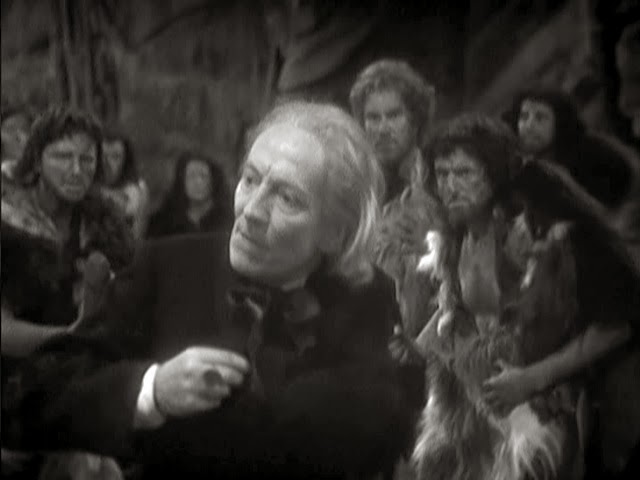
It starts out with Team TARDIS being ambushed on the way back to the ship.  But it's kind of okay because they were planning on taking the wounded caveman back to the tribe anyway, much to the surprise of the one cavelady, who remarks that this new tribe treated them like a mother caring for a child. Still, no good deed goes unpunished in early 1960s Doctor Who and the four are tossed back into the Cave of Skulls - but this time, they aren't tied up (maybe that was the tribe’s idea of mercy, who knows?) Either as a last-ditch attempt to get the cavemen to let them go or out of sheer boredom (or both), Ian, Barbara and Susan work together to try to make fire.

I sort of feel like I need a peppy song about teamwork to go here.
And here, we get another interesting scene that informs on future interactions within Team TARDIS. The would-be caveman leader comes into the cave and sees Ian trying to make fire the old-fashioned Scout Camp way with a couple of sticks, some string, and dead leaves. The caveman asks if Ian is the leader of their tribe and Ian defers to the Doctor. He doesn’t give a reason for doing that - maybe it’s because the Doctor is the owner of the TARDIS and he’s the seasoned time-traveler or it could simply be old-fashioned deference and respect to someone older. Either way, it’s kind of a nice moment, considering the relationship between the Doctor and Ian up to this point has been prickly at best.

(Again, I don’t have much to say about the cavemen because I don’t find them that interesting beyond giving Team TARDIS an obstacle to overcome. But I do have to wonder - when you’re cast as a caveman and you’re told you’re perfect for the part, do you feel insulted or complimented? I’m asking for a friend...)

Caveman discovering fire for the first time or your typical fifteen-year-old Boy Scout? Really, is there a difference?
Anyway - back to the story. Another part that I absolutely love is when Susan starts fiddling around with the fire and she sticks a skull on top of a burning torch. For one thing, she’s gotten over her fear of dead things (which is remarkable, considering there’s a recently-dead caveman in there with them). And here we have one of the best escape plans in the history of escape plans - which probably only works because we’re dealing with superstitious cavemen here, but that’s beside the point

*obligatory Hamlet joke*
Ian gets the idea to stick four skulls on torches and pretend like they all died from - what? Fire exposure? Falling into the firepit? Poking each other with flaming sticks? (I tell you - boredom!) Who knows, but all we've got is a prank and a prayer and let’s hope this thing works! Which it does, funnily enough (hey, we've only got five minutes to close out and get back to the TARDIS!) While the cavemen are scared spitless, Team TARDIS takes this chance to sneak out the front door and take off running through the forest (*cough* BBC crew brandishing palm fronds *cough, cough*). The cavemen come to their senses at the last minute and give chase, but it’s too late. Team TARDIS has made it back to the ship and they take off, not knowing exactly where they’re going but at least it’s away from the cavemen.

Last one to the TARDIS gets out first on the next hostile planet!
Which still isn't good enough for Ian and Barbara. While these four did unite in their ordeal with the cavemen, once they get back to the TARDIS it’s back to the whole “Get us back home!” conflict. This is going to strain at the dynamic between the Doctor, Ian and Barbara with Susan caught up in the middle. It makes for a fascinating character study, even though it’s not at the forefront of the main story until “The Edge of Destruction,” which is among my very favorite Classic Who stories. This conflict is something that I quite like in these early days, though I am glad that it gets resolved later-on.


By the end of “The Beginnings” boxset, this Team TARDIS settles into a really neat little family dynamic that makes this group an iconic (dare I use that overused term?) set and would carry Doctor Who into it’s first wave of intense popularity. Sure, the Daleks were there to keep the public interest coming, but without these wonderful and compelling characters, even the cool-factor of the Daleks wouldn’t have been able to keep things going. Doctor Who was off and running from the very beginning and this story set forth the template for fifty years of great storytelling and madcap adventure, changing lives and influencing so many kids and adults to look at their world in a whole new light.

Or, simply to give us all something to look forward to.

***
Thus, ends the Librarian in the TARDIS: Unearthly Revisited series - I hope you've all enjoyed it as much as I've enjoyed going in-depth on the story that started Doctor Who.  I mean, we talk about the Daleks and how that really kicked things into high gear - but you really need some great core characters for the weeks the Daleks aren't terrorizing the universe and I think this initial story really gave the show a good foundation to work from. You don't get to 50 years without a solid starting-point and "An Unearthly Child" (or "An Unearthly Child" plus "100,000 BC" - whatever you want to call it) laid the groundwork in spectacular fashion.  In the weeks following, viewers would get caught up in the Daleks and the historicals and so many other great characters and plotlines - but this is where it all started and this is what we're all celebrating.

***
Previously -
Part 3 - The Best Out of a Bad Situation

Wednesday, November 20, 2013

The Best Out of a Bad Situation

Title: The Forest of Fear
Written by: Anthony Coburn
Team TARDIS: First Doctor, Susan Foreman, Ian Chesterton, Barbara Wright
Adversary: Cavemen and a really scary forest
Originally Aired: December 7, 1963

(Note: Soooo... Tragical History Tour had a bit of a tragedy in that their photo hosting service went toes-up on them (at least, for the next 24 hours). Thus, I'm going to have to do without screencaps for this post. Yes, I could try to make my own... but no one really wants me to do that because they'd look horrible. We'll just have to make-do with some links to Tumblr).

My Review:

I left the review of “The Cave of Skulls” on a character development cliffhanger. Now, have you ever been scratching a dog’s tummy and all of a sudden the dog started thumping it’s hind legs, meaning that you’ve found the sweet spot and you’d better keep scratching there because, oh boy, that’s just right? (okay, maybe it’s just my dog that does that). That’s me when a story gives me some great characters with great development. That’s probably why I stuck with the First Doctor’s era so long when I was first getting into Classic Who. Lots of veteran fans tell you not to plow through Classic Who from the start because you’re going to get bored. Well, in my case, that was most certainly NOT true. It started in the previous episode, but it really ramps up in “The Forest of Fear.”

Now, I've always considered the four-part serial known as “An Unearthly Child” to really be two stories. The first episode is its own stand-alone plotline and the subsequent three episodes are another story arc. Which makes “The Forest of Fear” the second part in a trilogy. And, generally speaking, the second parts of trilogies are usually the weakest installment. The story neither begins, nor ends. It’s just there to (hopefully) move the story along until it can be concluded, but not to actually end. I can think of several book trilogies that this applies to - the second book in the Divergent trilogy by Veronica Roth is kind of a muddled, meandering mess and the second book of the Matched trilogy by Ally Condie sticks out like a sore thumb between two very good installments. Also, traditionally Classic Doctor Who has this thing where the second-to-last episode of a serial is more or less killing time until the final episode comes in to end the story and interest kind of lags a bit. So... “The Forest of Fear” already has the deck stacked against it.

That’s not to say it’s a terrible episode. It’s just not the best that we've been given up to this point. And that may say more about the quality of the first two episodes than it does about this one. Because there are still good things to say about it - but they’re a bit more subtle and require some retconning to make work. Luckily, I've spent quite a bit of time on Tumblr and this “headcanon” stuff is like oxygen (which is kind of hard to come by over there, what with all the breathless fannish-flailing. I regret nothing!)

Fear Makes Companions of Us All

When last we left Our Intrepid Heroes... they’d been captured, tied up, and tossed into the Cave of Skulls. Things look pretty bleak for Team TARDIS. So bleak, in fact, that this scrappy little group of time-travelers - thrown together by the most bizarre circumstances - actually start to work together to find way to get out of the situation they’re in. And this, dear friends, is where the famed Man of Action Ian Chesterton comes to the forefront. Ian’s skepticism and doubt has completely vanished at this point. There’s no point in trying to deny that this weird stuff is happening anymore - Here is a problem and he’s going to solve it by being the default leader of the group.

I talked in the last review about how Barbara was the one willing to accept time travel and Ian was the one who had to be convinced of the reality of the situation - really, he only gave it a chance when he saw how adamant Barbara was about it. In this episode, there’s a bit of a role reversal which I find completely fascinating. It’s not a straight-across-the- board sort of thing, but Barbara’s given into despair and panic and Ian’s the one who has to pull her out of it. Personally, I rather like that trade-off between the pair of them. They both have their strong moments and their weak moments, which makes them each such realistic and relatable characters. This episode is chock full of moments where Ian and Barbara are shown to be almost perfect foils to each other. Really, I can’t think of any of their stories where that doesn't happen at least once. Some of that is down to the writing (I remembering reading somewhere that early drafts of these scripts did include hints of a romantic subplot between Ian and Barbara - oh, hey, here it is!), but I think most of that is because William Russell and Jacqueline Hill have such awesome chemistry together. Their performances create such a unique relationship between these companions and it gives me chills every time I see it (someone said recently that Ian and Barbara are Classic Who’s version of Rory and Amy before they got married. Can’t say that I disagree).

(Not to mention providing Tumblr with some excellent out-of-context screencaps for all your shipping needs).*

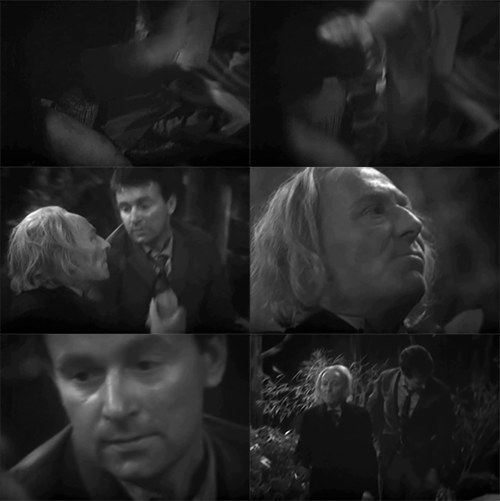
Well, that fills the shipping quota for this review (pun very much intended) - what about the other half of Team TARDIS? At this point, Susan’s just sort of... there. Though I do have to say that, given how the Doctor is acting, Susan deserves some admiration for being as positive and cheerful as she is in this episode. Because the Doctor is a far cry from the “can-do” hero that I had come to know from New Series Doctor Who. Honestly - I really like that he’s a bit of a coward early-on in this incarnation. This takes some ret-conning, but when have Whovians ever been shy about that? The First Doctor has even said that he doesn’t like Earth or the 20th century - but his granddaughter loves it. The Doctor holds nothing but disdain and contempt for Ian and Barbara. And, honestly, Ian doesn’t think very much of the Doctor either. The only reason Ian just doesn’t take Barbara (and maybe Susan) and leave the Doctor behind is because the Doctor’s the only one who knows how to fly the TARDIS (well, Ian’s sense of honor and decency probably plays a part in not wanting to leave a frail old man behind for the cavemen to... do whatever it is the cavemen would have done). In the grand scheme of things, this does wonders for the Doctor’s characterization and growth.

Any Hope Is Better Than None

And then, we come to the famous “the Doctor almost brains a caveman with a rock scene.” Which, I totally missed that on first viewing. After Team TARDIS has been fleeing through the eponymous Forest of Fear for the past ten minutes, the caveman-leader-dude and his ladyfriend - who have been pursuing Team TARDIS at this point - get attacked by some ferocious creature (totally off-screen because I highly doubt any kind of zoo animal was in the BBC budget at the time). After much screaming and an implied bloodbath, the caveman is seriously injured - and Team TARDIS can get away! Except... Barbara feels bad about leaving the poor caveman to die and she goes to try to help. Recognizing that this would be the right thing to do, Ian and Susan follow suit. And the Doctor... picks up a rock and decides that he is going kill their would-be attacker because that means they’ll get out of there quicker.

(Never let it be said that the Doctor was one to follow the crowd).

But the Doctor doesn't get the chance to follow through with his plans because Ian stops him almost as soon as the Doctor picks up the rock. And it’s just such a fast moment, but the Doctor is lost for words - almost for the first time since we've met him. And it’s more than just this one little plan has been foiled or that he’s cross that he hasn't gotten his way (as Susan says) - but I think this moment is when the Doctor starts to think that maybe humans aren't so beneath him as he once thought. He sees how Ian and Barbara are concerned over the injured caveman, how they clean him up and work to take him back to the safety of his tribe, even though it may mean they get captured again. And the only reason I think that this starts to change the Doctor is because that’s the kind of quality that I saw in the Doctor’s later lives. He doesn't seek to kill anyone and he doesn't look for violence or trouble. Obviously, something happened to change him and all that started with Ian and Barbara showing kindness and compassion to an adversary. If nothing else, that’s what “The Forest of Skulls” should be remembered for - the tiniest moment that started the Doctor on his path toward being better than he started out being.

Certainly, the Doctor’s character development goes on over the course of a very long time and we don’t actively see it played out on screen (beyond noticing differences in how William Hartnell plays the Doctor as time goes on - but you actually have to be paying attention to it because the change is so subtle). There’s a lot of reading-between-the-lines involved, but that’s something I totally enjoy and love, which is why I adore the First Doctor’s era so much. I've said this before with Classic Who (and I’m certain to say it many more times), but there is tons and tons of depth to these stories and so many people fixate on the effects or the low-budgets or the fact that these were filmed “as-live” or even that they’re in black and white and never see beyond those ticky-tack, nit-picky things to find the delicious meaty chunks of plot and story and character. And that’s totally unfair to these stories - but then again, that leaves more for me to enjoy. So - there!

***
*All joking about screencaps aside, Katie and Claire of Unwilling Adventurer actually go out of their way to provide context and analysis in everything related to the First Doctor's era. They're the best fan-create resource on the Hartnell era that I've ever seen online and I highly recommend their most excellent Tumblr.  As a bonus - here's their analysis of "An Unearthly Child" that they posted on the anniversary last year.  But don't think they never have their fangirl-flaily moments - oh, boy do they ever fangirl! :)

***
Next Time, on Librarian in the TARDIS: Unearthly Revisited
Part 4 - This story is ending, but the adventure never ends!

Previously -
Part 2 - Baptism By Fire

Tuesday, November 19, 2013

Baptism By Fire

Librarian in the TARDIS - Unearthly Revisited, Part 2

Title: The Cave of Skulls
Written by: Anthony Coburn
Team TARDIS: First Doctor, Susan Foreman, Ian Chesterton, Barbara Wright
Adversary: Kal and the Cavemen (sounds like an 80s punk-rock band, doesn’t it?)
Originally Aired: November 30, 1963

Synopsis (basically the same as yesterday)

Again - screencaps from Tragical History Tour

My Review:


"The Cave of Skulls" is really a story of two halves. There's the wrap-up of what was left over from "An Unearthly Child" - convincing the audience that, yup, we've time-traveled. And then… there's the caveman storyline. Which, I'm going to freely admit, I've never been that invested in. As far as I'm concerned, the cavemen serve only two purposes: (1) To prove that the TARDIS can travel in time (see also: "The End of the World") and (2) to create drama and conflict for the four main characters to interact with. The whole thing with making fire - eh, not that important. At least, not in and of itself. Mostly it’s there just to make Team TARDIS look good on their very first outing.  Which makes sense, when you have this core group of the Doctor, Susan, Ian and Barbara that you're going to be following throughout this series, you want the audience to connect with them.  You're not terribly concerned about these periphery characters that are just there to propel the story onward.

But that doesn't mean there’s nothing here to love. Most of fandom may just skip over these three episodes, but I've got plenty to say about them. So, let’s get going!

A New World For You


The Gallifreyans: Just another day at the office. The humans: ...the hell??
Once the cavemen characters have been established, the story cuts back to the TARDIS. Ian and Barbara are slowly coming back to consciousness from their first trip through the time vortex, and the Doctor and Susan are at the console, blissfully pretending that nothing out of the ordinary has happened. From this very first shot, you can tell that this isn't the first time the Doctor and Susan have done this. The image is very much that of Captain Kirk and his crew on the bridge of the Enterprise or even Han Solo and Chewbacca piloting the Millennium Falcon. Just another trip through time and another day to check the instruments. I seriously love that sight of complete normalcy on the part of the Doctor and Susan, but Ian and Barbara are in the background helping each other up with looks on their faces of "What the hell just happened?" It's one of my absolute favorite things about this serial!

I have no reason to include this picture other than I like it.
Now, through the last review, I often referred to Ian and Barbara together. They work together, they came to the junkyard together, they were kidnapped by the Doctor together. They're fantastic individual characters, but I love their interactions together. That being said, I love how this first scene establishes that there are times when they are such very different people. No where does this happen better that when the Doctor and Susan are trying to convince Ian and Barbara that they're not in 1963 London anymore. Barbara believes them a lot quicker than Ian does. There's even a sense that Barbara is eager to get out of the TARDIS and see things for herself. Ian… not so much. He's actually more argumentative about it - vehemently insisting that this has all been a trick and there's no way they could possibly be anywhere except the junkyard (or maybe he's a bit worried about leaving his car parked out on the street for who knows how long - that's just me reading between the lines). You really can't blame him at all - Ian's a scientist. He's made his life around experiments and scientific proof and what he can see in front of him. He doesn't trust anything he can't see, hear, or touch, so it's no wonder that he doesn't believe what the Doctor is telling him until he's actually outside the TARDIS doors - but he's also reluctant to go there. At least, until Barbara asks him if he's coming.

Remember how I said I wasn't going to fangirl-squee over Ian and Barbara anymore? You know I was lying, right?
(Side Note: Something I never noticed when I've watched this before is when the TARDIS doors open out into the wilderness, the Doctor takes off his hat. Maybe I'm reading too much into this, but he almost does it out of respect and reverence - as if William Hartnell did it on purpose to mark the historic moment when the TARDIS opened up onto an alien landscape for the very first time. Or maybe his head was itchy. Who knows?)

Disguising Itself Wherever It Goes

Nope. Definitely not Shoreditch anymore...
And here we get another brilliant piece of Doctor Who mythos - the TARDIS Police Box. That little moment when the Doctor first sees that the TARDIS hasn't changed and he's mumbling "how disturbing" it is, that used to bother me. Like William Hartnell wasn't quite putting his all into those lines. But then I thought about it some more and it makes more sense. Up until now, the Doctor has been the epitome of confidence in his time-and-space ship. Confident to the point of condescension, especially when he's dismissing Ian's protests that none of this can be possible. But then something goes wrong, and suddenly the Doctor's been wrong-footed. Suddenly, he isn't the smartest person in the room. He doesn't know why the TARDIS hasn't changed, but he doesn't want to admit that he might not be totally in control of the situation. So, he's going to run off and look for rocks or plants or whatever.


It falls to Susan to provide explanation. And seeing as how the Doctor's off… wherever... and Ian's still wondering "What the hell just happened?", Barbara is the one who's more keen on the newness of everything she's seeing. For reasons that aren't as easily explained as Ian's scientific skepticism, Barbara just soaking up this experience. She doesn't have a rational explanation, but she's more willing to go with it. She even admits that she doesn't really know why - she just believes that this is what's happening. So, it's fitting that Barbara is the one that figures out that the TARDIS is supposed to disguise itself wherever it goes. And, she actually sounds impressed by it. That one line is just so Barbara - she's rational and intelligent, but willing to accept new things that's she's presented with and add them to her ever-growing knowledge of the universe. It's something that I totally love about her character - and it makes her a perfect foil to Ian. In fact, that's probably the point when Ian starts to accept everything that's happened - he probably wouldn't have if Barbara wasn't willing to roll with it all.


Fire Will Kill Us All

I said that I wasn't too into the caveman storyline, and I'm really not. But I do have to talk about the end fight scene. Actually - before that. When the cavemen bring in the Doctor and the Doctor's laying unconscious on the rock, it's only when the Doctor wakes up that the scene gets interesting. Coming from New Who, I have no problems believing that this incarnation of the Doctor is still so very young and inexperienced. It's one thing to show off your shiny, futuristic toys to confuse people. But get him away from the TARDIS and all of his equipment - there's not much to him other than bluster. This is a Doctor early-on in his travels and he hasn't quite mastered the art of Social Interaction (compare this to later stories like "The Reign of Terror" when he convinces the jailer at Conciegerie Prison that he's some government official - well, a fluffy hat will do that). I know I'm coming at this backwards and a 1963 audience wouldn't have had that interpretation, but it's still something of note.

Caveman Negotiation 101 clearly wasn't covered at the Time Lord Academy.
Then, the cavalry arrives! For all the talk that Ian is the action hero (and he is, don't get me wrong!), it's interesting that Susan is the first one to jump one of the cavemen threatening her grandfather. Since realizing her grandfather was missing, Susan's been pretty much in a blind panic. I don't know how her travels with her grandfather have been up to this point, but I get the impression that she hasn't been separated from him very much, if at all. Plus, we're not sure of the circumstances of how they left their home planet. In many ways, Susan is probably a very lonely girl. I don't mind that she screams and panics a lot - many fans kind of dismiss her as just a screamer. But given everything that's implied to have happened to her (admittedly we don't know much - though I do know Big Finish has had some fun with pre-Unearthly Child stories), I really don't mind that she gets scared easily. In fact, I would be worried if she didn't get scared.

So, Team TARDIS gets captured by a bunch of irate cavemen who just want some fire (remember how Ian didn't have matches in the last episode? Boy, oh, boy he probably really wishes he had some now) and… what's this? The Doctor apologizes for getting all them into this mess? The condescending jerk that kidnapped Ian and Barbara and took them thousands of years into the past so they could get tied up and tossed into some smelly, disgusting cave?

Would you two on the left stop being all adorable and crap?? It makes it my job even more difficult!
That, my friends, is called character development. And there'll be more of it in the next episode!

***
Next Time, on Librarian in the TARDIS: Unearthly Revisited -
Part 3 - In which there is an enormous amount of running involved.

Previously -
Part 1 - All There in the Manual

Monday, November 18, 2013

All There in the Manual

Librarian in the TARDIS - Unearthly Revisited, Part 1

Title: An Unearthly Child
Written by: Anthony Coburn
Team TARDIS: First Doctor, Susan Foreman, Ian Chesterton (joins), Barbara Wright (joins)
Adversary: There really isn't one! (not for the first episode, at least)
Originally Aired: November 23, 1963

Synopsis (from TARDIS Wikia) -
Susan Foreman is a mystery to teachers Ian Chesterton and Barbara Wright, seemingly knowing more than she should about the past... and the future. Their curiosity leads them to follow her home one night, only to find that her 'home' appears to be a deserted junkyard. In the junkyard, they discover a police telephone box and a strange old man, who claims to be Susan's grandfather, and calls himself the Doctor. The journey of a lifetime is about to begin...

My Review:

I'm baaaaaack!

While my 50th Anniversary reviews of Librarian in the TARDIS are complete, the Doctor Who 50th Anniversary celebrations are far from over. This Saturday is The Day of All Days and what other fitting tribute would there be than to revisit the story that kicked off this fantastic story of a strange old alien and his time-traveling police box?

I thought about reviewing “An Unearthly Child” all together as it’s own little Bonus Review, but the more I thought and wrote about it (just from memory - I hadn't watched it for a while), I realized that every episode is packed with so much detail and nuance and I didn't want to miss anything good. And I’ll probably get other chances to discuss and dissect this story (and others like it), but the thoughts I had felt right for the 50th. So, without further ado - let’s get started with Episode 1!


(Screencaps from Tragical History Tour)

A Mild Curiosity in the Junkyard

I came to Classic Who in an interesting way. I mainlined New Who in a little over a month, watched the Paul McGann TV Movie, then found a copy of “The Five Doctors” on YouTube that incorporated elements from New Series (and probably gave a fanboys a fair number of heart attacks, now that I think about it). After the glorious sampler plate of “The Five Doctors,” I wanted to dive into Classic Who headfirst. Problem was, I wasn't sure how to begin. I knew there were any number of points I could start with, but honestly - I was intrigued by Susan. I didn't know much about her, other than she was the Doctor’s granddaughter and how cool would it be to get some of the Doctor’s personal background? (how precious was I?) I took the same attitude I did with New Who (and that I do with any new show that I start watching), that I really ought to start from the beginning so I can get all of the background and have a good foundation for these characters and stories. I don’t like missing out on inside jokes and references, quite honestly.

So, First Doctor it was. I located a copy of “An Unearthly Child” (*cough*) online and went to town.

Well - I first went to the junkyard.

One wonders how close this guy came to being the Doctor's first human companion.
The initial opening shots of the junkyard (complete with the police officer that recently became the longest-running character in the show, thanks to a certain little tribute trailer) are, quite simply, a brilliant choice for starting things going. Director Waris Hussein deserves all kinds of praise for this because it would have been so easy to start with the ordinary, everyday scenes of Coal Hill School and then ramp-up to the fantastical revelation of the TARDIS. But starting with the little tour of the junkyard (with the theme tune still playing hauntingly in the background) sets up for the audience that all is not normal in this sleepy little corner of London. There is a mystery to be solved and we the audience are clued in on it right from the beginning. This is not going to be a typical educational show for kids - this is going to be spooky and intriguing and FUN! And, even though I knew it must be coming, I got a real thrill out of seeing the police box through the fog and that strange, tell-tale humming just beneath the surface.


Now that I think of it - why a junkyard? The TARDIS had camouflaged itself as a Police Box - it could have easily been set out on the street corner, right? But the junkyard is another brilliant choice - either by the director or the writer, I really don’t know who it was but they were genius for doing that (I wonder if anyone’s ever asked that question). Junkyards have their own creepy atmosphere - it’s a place where no one ever goes, full of things that nobody wants anymore. It could be dangerous to go inside, even. It’s like putting the Wardrobe to Narnia in the Spare Room that no one uses - it’s a place that is unclaimed, unused, unorganized. Anything could happen (and it probably will).

Phew - two whole paragraphs on the first minute of screen time! Boy, I’m glad I split this thing up!

“Thank You For The ‘We’”


Now that the mystery and atmosphere of the show has been sufficiently set up, it’s time to bring in the mundane and ordinary - a tried and true formula that has been a storytelling staple for Doctor Who for 50 years. Coal Hill School. Just your average, run-of-the-mill secondary school with a bunch of average, run-of-the-mill students racing to get out of the building as the final bell rings before their average, run-of-the-mill teachers give them more homework or get after them for running in the hallways. Average. Run-of-the-mill. Nothing to write home about. Nothing at all.

Now, when I hit “play” on “An Unearthly Child,” I had no idea that the Doctor had ever traveled with more than one companion at a time. Well, that’s not entirely true - I’d been floored when I saw “The Five Doctors” and saw that the Doctor was accompanied by (what I thought he was at the time) a redheaded guy who probably worked in investment banking (that would have been Turlough. Seriously - I was completely clueless). So, I was more than a little surprised when the story didn't start with Susan, as I expected, but with her teachers.

To be perfectly, 100% honest, I had never even heard of Barbara Wright or Ian Chesterton. Which is really weird to me now because I’d known about Sarah Jane Smith and I’d heard of Tegan and Nyssa and Peri and Ace and the Brigadier and Jamie and Susan, but the Doctor’s first human companions were a complete surprise to me. Looking back, I like that Ian and Barbara were a surprise to me - probably because I was going into Classic Who thinking that I knew all the backstory the show had to offer and there was no way that I could be surprised in any major way (in my defense - I was still so very new at this and I didn't have any veteran Whovian standing by the guide me in this).

This will be the only time I fangirl-squee over these two this entire week. Seriously. The ONLY time.
(Yeah, you know I'm lying).
But what I totally love about these initial scenes with Ian and Barbara is how fast I went from “Who in the world are these two?” to “Holy crap! They’re amazing!” And really, they haven’t even done much - just expressed concern over a student that they've both had problems with. But you do get the sense that, while they’re both very set in their ordinary lives, they also have a lot of potential to be absolutely magnificent. It’s much the same with Rose Tyler when the series came back. And this isn't the first time (as I’ll point out here in a bit) that Russell T Davies took cues from the Classic Series when he was crafting New Who. Ordinary people with ordinary lives on the brink of an extraordinary adventure.


Something else that I hadn't clued into until much later, but that I really love, is that from the get-go Ian and Barbara have a really strong relationship with each other. Whether you “ship” them romantically (as I do) or if you just think they’re good friends, there is an unmistakable bond between these two that carries the first few stories (and, arguably, much of the first season) and that bond immediately creates a bridge between the story and the audience.

I know I’m getting ahead of myself here, but there are moments when the Doctor is being downright unpleasant and unlikeable that it’s really jarring (especially if you’re coming from New Who). But then Ian and Barbara say something to each other about it you’re back on board with the story.  For myself, it was reassuring that I was still watching the same show that I'd fallen in love with - there was an unspoken promise that this irascible old man would most certainly become the character that I knew and adored, I just had to give him time to get there. And really, that’s what kept me watching throughout these four episodes - I was still getting used to the different format coming from New Series Doctor Who and I hadn’t quite gotten my feet under me (so to speak). But I had Ian and Barbara to connect me to the rest of the story and as long as they were doing awesome things (which is pretty much all the time), I fell right in with everything else. They’re two of the absolute best companions ever in Doctor Who - and I’d even argue the foundations for these two characters are the basis for all future companions.

“What Are You Doing Here?”

So, Ian and Barbara go poking around in the junkyard looking for Susan (no way she could possibly be in that old police box... that's humming?) And - eleven minutes into the first episode - the title character arrives, waving his scarf around to clear the dust and examining all the junk lying around the place. Ian and Barbara (rather politely) ask this mysterious old man if he’s seen a young girl and the old man completely blows them off. It’s obvious the Doctor is hiding something - and Susan doesn't make it easy for him to keep his secret hidden, still calling out to her grandfather from... somewhere?


William Hartnell’s first appearance as the Doctor sets the tone for his character beautifully - indeed, it sets the tone for how the Doctor is going to treat Ian and Barbara, at least for the foreseeable future - but it also gives him room for character development. They’re bothering him. They’re in the way. They’re going to expose his closely-guarded secrets. Still, underneath all that bravado and bluster lies the beginnings of a spark of that very first Team TARDIS. Even before their characters truly know each other (as far as the story’s concerned), William Hartnell, William Russell and Jacqueline Hill positively sparkle in this first scene together and you just know that this is the start of an amazing team (well, I was excited about it, anyway).

The start of a beautiful friendship (eventually...)
A Thing That Looks Like a Police Box

One of the coolest things about the Doctor Who’s revival in 2005 is how much stuff Russell T Davies not so much “borrowed” as outright stole from “An Unearthly Child” when he wrote “Rose.” Both episodes start out with the Doctor’s soon-to-be companions in their normal, everyday lives. Both progress as the result of these normal, everyday lives being disrupted by the smallest weirdnesses. And both introduced the inside of the TARDIS - not in this grand, upscale camera shot, but by the companion’s initial reaction. The audience saw Barbara’s face before we saw the inside of the TARDIS and the same thing would happen with Rose 42 years later. It’s a genius move to create a sense of wonder in the audience, by first creating a sense of wonder in the characters we've already connected with (Hey, don’t fix what ain’t broke!)

Audiences and companions' first entrances into the TARDIS, from 2005 and 1963
And here comes The Exposition! In general, exposition can be really boring if not handled well, but for setting up the whys and wherefores of how this new science fiction program will operate - I have a damn hard time imagining that Verity Lambert and company didn't set up the entire Doctor Who mythos right from the very beginning. Even though I've heard stories about how most everything was done on the fly and by sheer luck and coincidence, the story is told with such utter confidence in everything that’s going on, you absolutely believe that there is already a plan to reveal the Doctor and Susan’s home planet and the circumstances of their exile. Sure, they don’t outright mention Gallifrey or Time Lords or regeneration (and those things wouldn't even be invented until years later), but coming from New Who, I feel like there’s a certain amount of mystery to be explained later. Indeed, there’s an unspoken promise that it will be explained later, but right now we've got the universe to explore!

Not exactly an average Parent-Teacher Conference, is it?
Here’s kind of an odd example of what I’m talking about - I've recently gotten into the show Person of Interest. Over the show’s first season, most of what we learned of the reclusive-yet-lovable genius billionaire Harold Finch was directly tied into the background of the Machine he built for the government that spies on people. We learned very little about his personal life that wasn't related to that project. But in Season 2, we do get more of his backstory that we knew must be there, but it was never a point of discussion in Season 1 because there were other things going on that directly related to the premise of the show.

The Doctor is very much a Harold Finch-type character - reclusive, eccentric, standoffish at first, but just a big squishy teddy bear once you come to know him. We know he’s protective of his granddaughter (and rightfully so - we don’t know the nature of the Doctor and Susan’s exile, but we know enough that the situation is dangerous for them both).


I've really got to talk about Susan here. Because what makes this Team TARDIS work is the connection that Susan has to her grandfather, but also the connection she has to 20th century Earth and, by extension, her schoolteachers. While the Doctor insists that he merely “tolerate[s] this century but [doesn't] enjoy it” in this first episode, Susan has already fallen in love with this planet, its customs and people. I have no doubt that love eventually inspires the Doctor to adopt Earth as his second home planet. There are other reasons that come later (in these reviews, in fact!) that the Doctor would start to soften his attitudes about Earth, but it wouldn't have happened at all if it wasn't for the innocent and sincere curiosity that Susan exhibited from the outset. Susan’s heart and tenacity make her a very unique companion - these qualities don’t get exhibited much in other companions (I think you could make a case that Jamie is that way - possibly even Rose, in some ways) and that really endears her to me. Here’s a young girl whose was obviously very close to her grandfather. She’s got his same desire to explore new worlds and she gladly tagged along for the ride when he ran away from Gallifrey. She enrolled in a primitive school on a primitive world in order to more fully understand the people of this planet - which, that has courage written all over it. And she doesn't shy away from a challenge. Sure, she’ll have moments where she’s scared out of her wits - who doesn't? But you have to admire a girl for trying new things!

Wanderers in the Fourth Dimension

And here’s the moment of truth. Ian and Barbara try to leave the TARDIS, but the Doctor locks the doors and takes off with them still inside - looking positively horrified at what could possibly happen next. Not much is said after the TARDIS takes off - there’s an extended sound effect of the TARDIS taking off, Ian and Barbara are knocked unconscious (because of the stress of first-time time traveling? Heck, I don’t know - it never happens again), scenes of London fall away as the ship rockets off into space and time...


...and comes to a stop on a desolate, rocky plain with a menacing shadow stretching across the landscape. The credits roll and the theme tune plays. Jaws are picked up off living room floors across the UK. For the second time in two days, history has just been made. This time it’s not an assassination an ocean away, but one scrappy little family tea-time program that’s going to be the talk of the town - a program that won’t soon be forgotten.

(Okay, I’m just imagining how things would have been for the average television viewer in the UK in November 1963 - but it’s as good as anything else, right?)

We're not in Shoreditch anymore...
There’s just so much packed into this one little 22-minute episode that I could have gone on and on about characters and story and plot elements. The writing is tight and engaging, there’s just enough mystery left to keep you excited for the next part - which will be the topic tomorrow. While “An Unearthly Child” has the reputation of being a stellar piece of television and the succeeding three episodes... not so much, I’m certain I can find something compelling to talk about in each one. Hell, it was good enough for the audiences to stick around before the Daleks finally showed up.

(Aw man... I wanna go watch this episode again!)

***
Next Time, on Librarian in the TARDIS: Unearthly Revisited -
Part 2 - Caveman politics - bah! Let's talk character development!

Thursday, November 7, 2013

Go Forward In All Your Beliefs

Librarian in the TARDIS, Epilogue


Well, kidlets. It's been seven months (near enough) since I embarked on the Librarian in the TARDIS blogging project to celebrate the 50th Anniversary of Doctor Who.  I feel like I've only scratched the surface of what there is to dive into with this remarkable franchise. And hopefully there will be more adventures and characters to love and talk about over the next 50 years (man, I can only hope I'm still doing this fandom thing when I'm 78. That'd make me one of the coolest grandma-types ever!)

I didn't want to just leave Librarian in the TARDIS without a proper send-off (because not even Dodo Chaplet deserved those kinds of shenanigans).  And I'm certain that I will add to the tag in the future because, honestly, it's too good to let languish in the annals of the Internet.  It's been good to have a structured formula in which to review Doctor Who stories in various media while also showing some love to some of the unsung gems of the TV show. I said at the outset that I wanted to give some neglected stories a closer look and bring in a fresh perspective from a relatively new fan because some of the Good Old Boys of fandom tend to recycle the same old reviews and opinions over and over again. I mean, in theory, everyone says “It’s okay to disagree” and everyone says they'll play well with others - but when it comes to actually expressing a dissenting opinion... people aren't as nice.

It’s also been good to explore Doctor Who “canon” (I use the term loosely) in other media. I've enjoyed Big Finish for a very long time and I would love to delve into more stories and story arcs as I am able. And reading the novels has simply been a treat. I hope this 50th Anniversary reprint range has done well-enough that BBC Books sees the value in making more of these novels available whether in hardcopy or digital formats because I would love to read more of them.

Just to close a few things out, I have a few “fictitious awards” to hand out. This is probably the most self-serving part of this blogging project, but it was the best way I could think of to really recap and close out this whole thing. So, without further ado, I present -

The Librarian in the TARDIS Awards Show!

(Super-creative naming convention, I know).

Biggest Surprise: How much I loved “Meglos.” This was an entirely new-to-me story and I had no idea if I would like it at all, let alone even “just a little bit.” But I LOVED it! Not just for the return of Jacqueline Hill to Doctor Who (though that in itself was beyond cool), but just how creative and imaginative the story was AND how they made the whole thing work. The writing was really engaging and fun and I absolutely adored the whole thing from start to finish.
Honorable Mention: Bonus Review for “The Enemy of the World.” I’m pretty sure the news of recovered missing episodes was a huge shock to a lot of people (even if you had been suckered-in by all those nutty rumors, the fact that they actually turned out to be true was still a surprise), but the mere fact that I enjoyed the story so much to want to include it in this blogging project was a very nice surprise and one that I was glad to have (and I must thank the boys at Traveling the Vortex for including my “Enemy of the World” review on their website - they’ve been great supporters and friends throughout this entire endeavor and I'm really appreciative of all they've done).
Something That Went Exactly I Way I Planned It: Reviewing the Sixth Doctor’s era. This era, more than any, was the one I had mostly worked out in my head from the start and it didn’t change much as I went along. When you’ve set out to complete something by a certain date and you’ve set a structure for yourself, sticking to a schedule is sheer gold.
The Sixth Doctor Reviewed:
Review 6.01 - Telling Conventional Fan Wisdom(tm) Where to Stick It (TV: Timelash)
Review 6.02 - Hello Doctor. It Is So Very Nice to Meet Me. (Audio: The Wrong Doctors)
Review 6.03 - A Meeting of History and Morality (Audio: Medicinal Purposes)
Review 6.04 - The War Games People Play (Prose: Players)

Review I’m Most Proud Of: “The Curse of Peladon.” Hands-down, this is the one that I think turned out the best. I really got down into the nitty-gritty of the characters and their motivations and a few things that Maybe, Sort Of, Could Have Happened (this being referred to on Tumblr as “Headcanon”). I’d never delved so much into the character of Jo Grant and that story gave me the opportunity to really dissect and take apart what makes her such a good companion for the Third Doctor. Getting into those details is something I enjoy and I think it was evident in my analysis of the review and I was very pleased with how that one turned out.
Honorable Mention: “The Last Post” - same thing with Jo in “The Curse of Peladon,” but with Liz Shaw. We got so little of Liz on TV, but Big Finish gave so much more detail with her character and background and that was a treat to get into.

Something That Changed My Mind: This wasn’t one particular review, but in the course of revisiting the Fourth Doctor’s stories, I was surprised how much my opinion of Tom Baker’s Doctor. I never actually hated his Doctor, but I just never really understood why he is considered by so many to be the bestest best Doctor in the history of EVAH! I just put it down to simple longevity and childhood nostalgia as being the reasons people liked him so much, but that didn’t mean I had to like him. But I also didn’t want to just sit here and be all “You fanboys’ tired old opinions are stupid, let me fix them for you” because that makes me no better than those who trot out Conventional Fan Wisdom(tm) as The Only True And Final Word And Anyone Who Thinks Otherwise Is An Idiot. In the spirit of revisiting and rethinking old opinions, I decided some of my own negative perceptions needed to be revisited as well. And I am glad that I gave the Fourth Doctor another chance because he is quite good. I’m starting to see the appeal. Does that mean it’s something that appeals to me personally? Not really. Four still isn’t my Doctor. But I can see how he would be someone else’s. And that’s surprising enough.

(I still think it’s stupid that everyone loses their crap over “The Talons of Weng-Chiang,” though).
The Fourth Doctor Reviewed:
Review 4.01 - Fill My Eyes With That Double Vision (TV: The Android Invasion)
Review 4.02 - Haven't I Seen You Somewhere Before? (TV: Meglos)
Review 4.03 - So Much Cooler Online (Audio: Babblesphere)
Review 4.04 - Well... That Was... a Book. Yup. Definitely a Book (Novel: Festival of Death)

Biggest Disappointment: “Ten Little Aliens.” I’m sorry - there just have to be better First Doctor novels that they could have chosen for the reprint range. I kind of feel like they expect that people don’t care for the First Doctor, so they just pulled whatever random story they could grab off the shelf and that’s what they did. It’s not representative of the First Doctor’s era and it’s just not a very good story. Not a great start to the set - but I guess they figure people would go for the Fourth Doctor or the Tenth Doctor books first and maybe work their way around (or skip the First Doctor entirely? If that’s the case - that’s a shame).


The Review I Wanted To Write For A Long Time and Finally Got To Do It: “Warriors of the Deep.” Simply because every time I heard some elitist literati fanboy goob deride and run down this story as “The beginning of the end for Classic Who,” I wanted to reach through my iPod or the computer screen and slap them silly. Because all they ever looked at was the surface problems of the effects or props or sets (which, there are many - I will not deny that), but they never gave the story any credit at all! In many ways, this review was a year or two in the making and I finally got to say my piece - and even have a link to give to people when they started in on the story. “Oh, you and everyone you know thinks ‘Warriors of the Deep’ is a steaming pile of garbage and deserves to be crapped on further? Here, read a dissenting opinion.”

Now, I don’t imagine for one second that I’ll change many minds with this (other than Vortex Glenn, who has a really nice write-up on his blog about the story: Warriors Revisited), but it’s like Jack Sparrow shooting the undead zombie monkey in “Pirates of the Caribbean.” It may not do any good for anyone else, but it does worlds of good for Jack.

Favorite Team TARDIS: Everyone in “The Light at the End.” There. Made that one easy on myself. MOVING ON!

The Review I Want to Revisit (and probably will later): “The Keys of Marinus.” I’ve watched this story a few more times since I first wrote that review and there are a lot of little details that I didn’t mention the first go-around (to be fair, that was the first one I wrote and I was still figuring out my format). I want to give this one “The Curse of Peladon” treatment and really dive deep into the story and characters and maybe fill in a few gaps with some fun little Headcanon moments.

The Doctor’s Era I Most Want to Revisit (Not Necessarily Review): I’ve already kind of been doing it on my own, but I’ve become absolutely enamored with the First Doctor’s era. I partially lay the credit/blame on Katie and Claire, two sisters who run the First Doctor-era- themed Unwilling Adventurer on Tumblr. Some of their analyses and reviews have really got me thinking more about the stories of the First Doctor’s era and how much more depth there is to be found. They don’t just talk about TV stories, but also delve into audios and novels, some of which I’ve listened to or read, but their descriptions make me want to read and listen to more (if I only had an unlimited amount of money - and if some of those novels were actually, you know, available). I just feel like there’s a wealth of interpretations to be made here, something that I think a lot of people miss when they dismiss the First Doctor as just that cranky old Doctor that wasn’t really the Doctor because they were still figuring out how the show was supposed to be (which, I think is a ridiculous statement to make, given that William Hartnell wasn’t “The First Doctor” at the time. He was the only Doctor). Anyway - yay First Doctor!
The First Doctor Reviewed:
Review 1.01 - The Call to Adventure (TV: The Keys of Marinus)
Review 1.02 - I Think It's Gonna Be A Long, Long Time (Audio: The Rocket Men)
Review 1.03 - Recycled Christie Cardboard IN SPACE! (Novel: Ten Little Aliens)

Story Arc I Most Want to Revisit: I created this category purely for the purposes of listing the Hex story arc as one I want to really delve into. I reviewed “The Harvest,” which saw Hex joining the Seventh Doctor and Ace on their travels and I have listened to a few other Big Finish audios that tie into Hex’s backstory, but I haven’t gotten to the point where everything comes together in one great big picturesque storyline. I really enjoyed Hex in “The Harvest” and I want to see more of what’s in store for him. Also, for whatever reason, the addition of Hex made me enjoy Seven and Ace that much more. I really like that combination for Team TARDIS.

Biggest Cheat: There were several, but I think this goes to "The Forever Trap," which was the audio story I reviewed for the Tenth Doctor's era. This review was planned from the beginning, even though I wanted to get in as much Big Finish as I could.  But then I got to New Who and realized... "Crap - Big Finish doesn't do New Who stories! (they don't have the license!)" But then I remembered I had this little pseudo-Companion Chronicle/audiobook and decided it would be fitting to review that (and I love it a lot. So there's that).

Favorite Song Used In a Review Post: I enjoy making use of music and videos in my reviews, but the one I thought worked the best was "Double Vision" by Foreigner in my review for "The Android Invasion." That was a meeting of serendipity, I don't mind saying (thank you, iTunes Shuffle!)

And, finally, here are my own personal "winners" for my favorite stories our of everything I reviewed -

Favorite TV Story I Reviewed: "The End of the World" by Russell T Davies. This is the story that drew me into Doctor Who and kept me coming back for more and a HUGE reason I'm sitting here writing these reviews and celebrating this anniversary year.

Favorite Audio Story I Reviewed:  "The Rocket Men" by John Dorney (he's written some other really, really good Big Finish stories too - go look them up). I'll be honest, this has been kind of a recent thing for me, but I simply adore the First Doctor's era. And I love, love, love, love Ian and Barbara to pieces! They're both fantastic characters individually, but put them together and they are just dynamite! (enough that I overuse italics and exclamation points when talking about them). I shipped them the first time I saw their stories (because, seriously - how can you not?) and I loved that there was an officially-licensed story that just had fun with that relationship. And William Russell's performance in that story is simply fantastic and I loved every minute of it.
Honorable Mention: If I'm completely honest, I very nearly gave this to "The Forbidden Time" by David Lock. I love the Companion Chronicles range and I love it when they have more than one companion in the story. Really makes me excited for the new Early Adventures range Big Finish has planned for next year. Plus, Anneke Wills and Frazer Hines are great on their own, but they are so much fun together!
Favorite Novel I Reviewed: "Fear of the Dark" by Trevor Baxendale. Simply for being a fantastic Fifth Doctor story and one that I won't forget in a hurry. I liked this one so much that, in addition to my initial eBook purchase, I also bought the paperback hardcopy to sit on my bookshelf next to "Beautiful Chaos," which is another favorite novel of mine.

[Short PS - Hey! BBC Books! If you’re reading this, could you please reprint all those Classic Doctor novels and novelizations? Or at least make them available as eBooks? There are plenty of fans who’d pay good money for that stuff! We’re waiting!! (I do have to give them credit for producing audiobook versions of the Target Novelizations, though).]

And, finally - finally!

Favorite Story I Reviewed Regardless of Media: “The Wrong Doctors.” For all my insistence that reviewing the Sixth Doctor’s era went off exactly as I planned (and it did), when I decided to review two Tom Baker TV stories, I thought it fair that I do the same for Colin Baker’s audio stories. So, I chose “The Wrong Doctors” to go along with “Medicinal Purposes” because it was a recent release and I already owned it - I just hadn’t listened to it yet. But it was so much fun and I loved it to bits and Colin Baker is so great in the audios and I could listen to his Doctor read the phonebook (I’m certain that some fun jokes would come about for that). Plus, it gave Mel some much-needed character and backstory and I will never argue with that.

And now - because this is what award shows do - for the final celebratory musical number:


***
I hope some of what I've had to say has given my readers a new perspective and maybe helped you look at these stories in new and interesting ways. And maybe we had some fun along the way.

Don’t think that Librarian in the TARDIS is going away anytime soon. I’ll still write reviews of Doctor Who stories under that tag and with the same format (it makes writing reviews easier if I have the synopsis, etc. from the outset). I also have a few more surprises in the works for the next couple of weeks before the 50th Anniversary actually airs, so don’t go away!

***
Previously, on Librarian in the TARDIS -
Review 11.2 - The Weather Outside is Frightful