Showing posts with label historical fiction. Show all posts

Thursday, May 15, 2014

Throwback Thursday: Courage, Integrity and Conviction - Review of "The Boy Who Dared" by Susan Campbell Bartoletti

**Originally Posted on cj's bookshelf on July 29, 2011**

Title: The Boy Who Dared: A Novel Based on the True Story of a Hitler Youth 
Author: Susan Campbell Bartoletti
Publisher: Scholastic Press
Publication Date: February 1, 2008
Reading Level: 13 and up

Synopsis: (from Goodreads) –
Just as the Nazis are rising to power, Helmuth Hübener, a German schoolboy, is caught up in all the swashbuckling bravado of his time. The handsome stormtrooper uniforms, the shiny jackboots and armbands, the rousing patriotism all serve to draw him into this bright new world full of promise and hope. In the beginning his patriotism is unwavering. But every day the rights of people all over Germany are diminishing. Jews are threatened and their businesses are being destroyed. The truth has been censored, and danger lurks everywhere. Anybody can turn on you. The world has turned upside down: Patriotism means denouncing others, love means hate, and speaking out means treason. How much longer can Helmuth keep silent? Told in flashback, Newbery Honor Book author Susan Campbell Bartoletti magnificently explores the life of a heroic German youth who dared to stand up against the Nazi regime.

My Review:

Where has this genre been all my life?

Okay, okay – I need to clarify here.  I read plenty of books about World War II and the Holocaust.  I read The Diary of Anne Frank and Number the Stars in school.  I even went to the Holocaust Memorial Museum on a school trip to Washington DC in 8th grade (which was hands-down the most memorable stop on that trip.  I don’t remember all the quotes from the war memorials or everything from the Smithsonian – but I remember every single minute I was in the Holocaust Museum.  It will haunt you, disgust you and inspire you to be the very best of humanity. Sound weird, but it’s true).  Most of the things I’ve read or heard about the Holocaust come from the Jewish victims with a little flavor of people who helped Jews hide.  But I have rarely read books about Germans in the 1940s who did not agree with the Nazi plan and even risked their lives to oppose Hitler.

Now, however, I've read The Book Thief and The Boy Who Dared – and my heart breaks for those people.

The Book Thief introduced me to the concept that there were Germans who opposed the Nazis (I sort of knew that was the case, but I really hadn’t thought about it very much). Reading The Boy Who Dared drove this point home with me.  Not all Germans were marching in the squares and Heiling Hitler at every turn and corner.  So many of them just wanted to provide for their families and be good people at a time when doing one meant not doing the other.

For most of my life – indeed, for many in my generation, World War II seems like such a distant time in history.  You learn about it the same way you learn about the pilgrims, the American Revolution, the Civil War and the Great Depression.  They are just dates and names in the history book that don’t mean much.  I thought so too – until I realized that my parents were born not even fifteen years after the war was over.  And then I thought that fifteen years really isn’t that long of a time period.  It felt that way when I was a kid, but I’m older now.  And it gives me chills.

I've often wondered how the Holocaust was allowed to happen.  Even after all my study and learning how the yellow Stars of David and mandatory curfews and segregated schools slowly became the concentrations camps, it still baffles me how this could happen.  I'll be honest, it scares me to death. You have a country hurting because of an economy that is completely and totally in the sewers because of losing a war, the entire nation was humiliated and they got desperate enough to let Hitler and his guys come in and hijack a country for their own power and personal gain and call it patriotism.

I just realized this review hasn’t talked much about The Boy Who Dared, but I think that’s because I just finished this book and it’s got me thinking about this.  For me, that is a sign of a magnificent piece of writing – that you don’t necessarily notice the writing style or the characters, but the content of the story.  Helmuth Hubener is a fantastic character.  I hesitate to call him a “character” because he was an actual person and these things really happened, but Bartoletti’s characterization of him is so wonderful and I enjoyed reading his thought processes and how he came to do what he did.  This is a seventeen-year-old kid who is illegally tuning into the BBC radio broadcasts and distributing fliers with news of the war from his radio.  But he didn’t just wake up one morning and think “Gosh, I’d really like to get arrested by the Gestapo, so I’m going to print up anti-Nazi pamphlets and really cheese them off.”  Everything he did was driven by the fact that he was taught to respect others and see people as sons and daughters of God and that patriotism does not mean demonizing an entire group of people just because they’re a convenient scapegoat.


The fact that this was written for the YA set – that you would trust teens enough to understand something like this (well, I would anyway) – speaks volumes to the importance of the topic and the reverence that people like Helmuth Hubener deserve.  Anyone even remotely interested in human history owes it to themselves to read this book.

Thursday, February 13, 2014

Throwback Thursday: The Bad Things Don't Always Spoil the Good - Review of "The Book Thief"

Throwback Thursday makes a triumphant return after a (unintentional) five-month hiatus! For those who missed it (probably a lot of you), I used to have a blog I used solely for reviewing books. But then I started doing more with this blog and decided to consolidate them both. I didn't want to lose all the work I'd done on cj's bookshelf, so I'm slowly migrating them over here. I started last year, but got distracted and kept forgetting to do it. But it's back for your enjoyment!

**Originally posted on cj's bookshelf on June 17, 2011**

Title: The Book Thief
Author: Markus Zusak
Publisher: Knopf Books for Young Readers
Publication Date: December 2005
Reading Level: Age 14 and up

Synopsis: (from Goodreads)
It is 1939. Nazi Germany. The country is holding its breath. Death has never been busier, and will become busier still.

Liesel Meminger is a foster girl living outside of Munich, who scratches out a meager existence for herself by stealing when she encounters something she can’t resist–books. With the help of her accordion-playing foster father, she learns to read and shares her stolen books with her neighbors during bombing raids as well as with the Jewish man hidden in her basement.

In superbly crafted writing that burns with intensity, award-winning author Markus Zusak, author of I Am the Messenger, has given us one of the most enduring stories of our time.

My Review:

Oh, "The Book Thief" - you wonderful, wonderful piece of writing you.

This book first came to my attention through the Mark Reads blog.  All I knew was that it was set in Nazi Germany and there was a girl who stole books.  How the two connected, I hadn't the foggiest idea.  But the themes connected in one of the most beautiful ways I have ever seen.

So many of the stories about the Holocaust and World War II and Nazi Germany focus on the horrible things human beings are capable of doing to other human beings and "The Book Thief" is no exception.  But what this book does so magnificently is telling the story of Germans who - surprise! - didn't actually buy into the Nazi propaganda.  In fact, there were plenty of Germans who were just trying to take care of their families and follow the rules and do what they thought was right.

The best thing about this story is Liesel Meminger, the titular book thief who finds joy and solace in the books she "steals" from various places (though one of those places is the mayor's wife's library - and the mayor's wife purposely leaves the door open for Liesel).  She is just a little girl who plays with her friends and gets into mischief - just like any other kid in any other time period, but her experiences are set up against the backdrop of Nazi Germany.  Her childhood is peppered with flashbacks of her foster father's experience in World War I, scenes of Death (the narrator) picking up souls killed in the war and scenes of the people in Liesel's neighborhood taking cover in a basement during bombings.

My favorite chapter is when Max Vandenburg - a Jewish man Liesel's family is hiding - illustrates a story as a gift to Liesel to thank her for her kindness.  I don't want to go into details about Max's story because it is so lovely and wonderful, but the whole chapter was a brilliant depiction of the story as a whole.

This entire story is an exceptional tale of the very worst of humanity sitting right next to the best of humanity.  It takes all the black and white morality in storytelling and sits it on the bench and lets the grays of real people shine through.  Nothing is ever straightforward, as much as we try to make things good and right.  But that doesn't mean you stop trying to live a good and moral life the best way you know how.

Monday, June 24, 2013

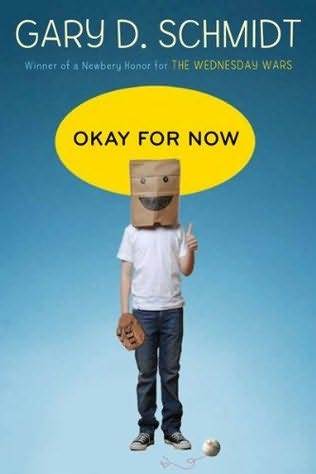
Navigating Childhood Without a Compass - "Okay For Now" by Gary D. Schmidt

Title: Okay For Now
Author: Gary D. Schmidt
Publisher: Clarion Books
Release Date: April 2011
Recommended for Ages: 12 and up

Synopsis (from Goodreads) -

Midwesterner Gary D. Schmidt won Newbery Honor awards for Lizzie Bright and the Buckminster Boys and The Wednesday Wars, two coming-of-age novels about unlikely friends finding a bond. Okay For Now, his latest novel, explores another seemingly improbable alliance, this one between new outsider in town Doug Swieteck and Lil Spicer, the savvy spitfire daughter of his deli owner boss. With her challenging assistance, Doug discovers new sides of himself. Along the way, he also readjusts his relationship with his abusive father, his school peers, and his older brother, a newly returned war victim of Vietnam.

My Review:

I started this book yesterday (Sunday) afternoon.  I finished it yesterday evening before I went to bed.  Barring a few moments where I actually had to put down the book and take a deep breath because of certain scenes, I pretty much read the whole thing straight through.

The whole story is told more or less in a stream-of-consciousness, which I'm not usually a fan of.  But for some reason, Schmidt's thirteen-year-old protagonist, Doug, kept me riveted to the story.  It's almost like Doug is telling the story all in one breath (except that the story takes place over the course of a year - but I guess you can do that kind of stuff in prose).  What's remarkable about this book is how Doug basically treats events in his life like they're no big deal, but you know that they're a very big deal to him.  But he doesn't want to let on that they mean too much to him because he's use to disappointment and he doesn't want to act like he's gotten his hopes up.

In so many ways, Doug Swieteck reminds me of Scout Finch from To Kill A Mockingbird. Doug is just a kid trying to navigate his way through events that are so much bigger than him and he does it in a way that his young mind can understand. The main difference between Doug and Scout is that Doug doesn't have the Best Literary Dad Ever to help translate these events into his thought processes and he more or less has to figure it out on his own (though he does have plenty of people to guide him along the way). The reader knows what's going on, even if Doug doesn't or can't say it in so many words. I love stories that can take a kid's point of view and make it compelling and honest - like reminding you what it's like to be a kid and have to deal with adults' problems when you don't quite understand why the adults are doing the stupid things they're doing.

I think another reason I connected with this book so much is that it reminded me of some things that have happened in my own family - much that happened long before I was born, but also some that I have vague memories of from when I was very little. Not all of it was good, but it's also a reminder that you can still love your parents and grandparents and aunts and uncles despite all the stupid things they may have done (and remember that your kids and your nieces and nephews may think of the stupid things you've done years down the road). I just have a lot of thoughts and feelings about this book and very little of it's really about the technical aspects of the writing and it's all about relating to the characters and the time period and how you deal with the world and make sense of it all when you're a kid. And I'm still trying to make sense of the world at twenty-eight.

But as long as I can find books like Okay For Now to help me work it out, well that's a pretty good start.

Sunday, June 9, 2013

Tell the World - "Rose Under Fire" by Elizabeth Wein

**This review is for an eARC version of this title**

Title: Rose Under Fire
Author: Elizabeth Wein
Publisher: Disney-Hyperion
Projected Publication Date: September 10, 2013
Recommended For Ages: 16 and up

Synopsis (from NetGalley) -

While flying an Allied fighter plane from Paris to England, American ATA pilot and amateur poet, Rose Justice, is captured by the Nazis and sent to Ravensbrück, the notorious women's concentration camp. Trapped in horrific circumstances, Rose finds hope in the impossible through the loyalty, bravery and friendship of her fellow prisoners. But will that be enough to endure the fate that’s in store for her?

Elizabeth Wein, author of the critically-acclaimed and best-selling Code Name Verity, delivers another stunning WWII thriller. The unforgettable story of Rose Justice is forged from heart-wrenching courage, resolve, and the slim, bright chance of survival.

My Review:
How many books - fiction and non-fiction - have there been written about World War II and the Holocaust?  How many of them have I read?  And how many of them leave me shaking and sick to my stomach? I almost wonder why I keep reading them. I'm sure I could find something more light and fluffy to enjoy.  But that would defeat the purpose, I guess.  But maybe that's why it's important to keep reading these books.

I read Elizabeth Wein's Code Name Verity last December during the nomination process for the Children's Literature Association of Utah's Beehive Award (Code Name Verity was nominated in the Young Adult category, in case you're interested).  That book hit me hard.  But I loved it.  So, when I saw Rose Under Fire on NetGalley, I knew I had to give it a go.

Rose Under Fire follows a similar format as Code Name Verity - it's the journal entries of Rose Justice, an American pilot during World War II who starts out as a delivery pilot for the Allies.  But she gets off course during a routine delivery and ends up as a prisoner of war in a German concentration camp.  She's the only American in the Ravensbruck camp, even though she's mislabeled as a French prisoner (clerical error - but that's the least of her problems).

The first part of the book describes Rose's day-to-day life on an Allied military base in England - it seems pretty tame.  Sure, she knows people who've been killed in the war and it's really bleak and there's not much to be happy about.  But she's safe and the Allies are well on their way to liberating Europe after the D-Day Invasion.  She writes in her journal about her friend and fellow pilot, Maddie (who readers will recognize from Code Name Verity).  Maddie gets married and things are going pretty good.

Then, suddenly the writing in the journal changes to letters talking about how Rose has been lost behind enemy lines and she's presumed dead and her family is grieving.  All within the first 25% of the book (my Kindle app doesn't have reliable page numbers - sorry).

Rose falls in with a ragtag group of women nicknamed "The Rabbits" because they were prisoners who survived the medical experiments the Nazis performed to research how best to treat war injuries and infections like gangrene.  They all look out for each other, even to the point of hiding the ones who they find out are scheduled for execution.  All the while, they hold out hope that the Allies are going to liberate their camp (the scene where they get the news that Auschwitz has been liberated is fantastic).

The entire book is lyrical, yet stark. Obviously, Rose survives to write about it later (she often refers to how she's now in a hotel in Paris recovering from her ordeal), but you're never quite sure if she really will.  She peppers her memories with poems that she wrote during her imprisonment and that poetry serves to remind you that these things happened to real people.

Rose's character voice is so real and so calming that I could almost handle the horrifying descriptions of the conditions of the camp and even the medical experiments the Rabbits were put through.  But the section of the book that got to me was the third part where Rose has to go back and testify against the Nazi officers who are on trial for crimes against humanity.  She can barely stand to hear her poems read in a university setting because it reminds her of that awful time.  It's like, she could survive actually being in the camp and fighting back against her captors, but once she's safe and people ask her about the experience after the fact, she can't do it.  That's the part that really got to me.

All through the book, the Rabbits tell Rose (they tell each other, actually) to "Tell the world."  Tell the world what happened here.  I think we see documentaries and read books about the Holocaust so much that we are kind of flippant about it, but this is one historical event that I think we shouldn't be.  When I was in eighth grade, I took a school trip to Washington D.C. and while I saw some really neat things there, two things have always stuck with me: The Tomb of the Unknown Soldier and the National Holocaust Memorial Museum.  When I read the descriptions of the camp and the medical experiments, I kept thinking of the exhibit at the Holocaust Museum that talked about the experiments they did on people there and I'm not sure if I really understood what I was seeing at the time.  Now that I'm older and I've had more time to think about it, I get it and it really shakes me up.  I don't know that I could go back and see that exhibit again, but I'm glad that I did.  As horrible and terrifying as this history is, the fact is that it's real and it happened and we need to remember it so that it never happens again.

Elizabeth Wein's books are stark and terrifying, but in a way that makes you think and remember.  It isn't sensationalized horror but honest, truthful, and jarring reality.  Both of these books - Code Name Verity and Rose Under Fire - should be on the reading list along with The Diary of Anne Frank and Night because they are just that good.

Wednesday, January 25, 2012

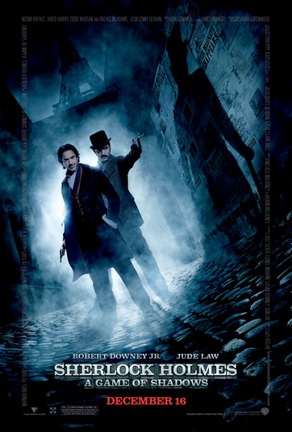
Review of "Sherlock Holmes: A Game of Shadows"

There are people who follow certain actors and actresses and are fans of a select few and absolutely must see every movie that their favorite person is in, never mind the quality.  That's all fine and good - everyone has things they like.  I am not one of those people.  For instance, I make no secret that I love David Tennant in Doctor Who and I really liked him in Hamlet and one reason for me wanting to see How to Train Your Dragon was so I could play "Blink and You Miss It" for his two measly-yet-credited lines (I have no shame).  However, I did NOT go out of my way to see him in Fright Night because I'm just not a fan of gory horror movies in general.  Honestly, I seek out movies that I know I would like regardless of who's in them.  It's the story that sells me, not necessarily the headlining cast (it is for this reason that I will indeed check out the rebooted Spider-Man with or without Tobey Maguire and Kirsten Dunst).

All that being said, I love Robert Downey, Jr.  He's fantastic in Iron Man and he's rapidly becoming one of my favorite actors, even though I haven't seen him in very much (call me a bandwagon jumper in this if you must.  Like I said, I don't follow a lot of actors).  Though I was a little wary of seeing him as Sherlock Holmes at first - would he be able to pull off the famous literary British detective that we all know and love (and what in the world is with the shirtless boxing? Not that I mind, but it's not something I associate with Holmes).  I didn't need to worry because that first Sherlock Holmes movie was really good - part of that has to do with Downey, Jr.'s chemistry with Jude Law, who plays Dr. John Watson (the straight man to Holmes' lovable eccentricities).  And sequels - Dear Sweet Gallifrey, I do love me a good sequel.

Sherlock Holmes: A Game of Shadows capitalizes on what I loves about the first movie.  If you're going to read any Sherlock Holmes story, you have to pay attention.  Even though Holmes explains the ins-and-outs of the conflict resolution by the end of the story, it still takes an alert audience to fully appreciate the intricacies of such things (and by "alert," I mean don't fall asleep before the ending).  The first movie did this very well and the second only intensified the intrigue.  Case in point - I usually have a notebook and take notes during the movie (don't laugh - I'm sure some of you have things I could point at and snort derisively).  But this time, I was too enthralled by the story and characters.  I don't know about Downey, Jr.'s other roles, but he has some spectacular dialogue, not to mention his delivery is a joy to listen to (as is his cadence as Tony Stark in the Iron Man movies - must be a thing he does).  The pacing of the story is really good too.  Not once did I feel like it was going too fast or too slow.  I love the choreography in the fight scenes and, yeah, I can buy Sherlock Holmes going at it mano-a-mano with the bad guys in the streets (and the pre-fight narration and step-by-step "Here's How I'm Going to Kick this Dude's Ass" is a nice touch too).

I've got to mention Professor James Moriarty here - because the first movie didn't have Holmes' arch-nemesis (being more or less an introduction to Sherlock), this movie was a great way to bring the best ever smarty-pants baddie into the franchise (seriously - Lex Luthor wears Professor Moriarty pajamas).  I'd never heard of Jared Harris, who plays Moriarty, but he was excellent and his back-and-forth with Downey, Jr. (I can't really say enough good things about the ending scene.  All they do is talk, but it's as good as any Big Time Explodey Ending you could find elsewhere).

What else?  The music is great, the costuming is fantastic (I love it when Holmes is in disguise and his makeup is just off enough that the audience can tell it's him - like the makeup artists planned that or something. Right?) Oh, and special shout-out to Mary Watson (played by Kelly Reilly) who has a great little badass moment of her own as she and her new husband are off on their honeymoon and it gets interrupted by a bunch of Moriarty's thugs.  Didn't expect it from her, but I guess if you're going to be married to Sherlock Holmes' best buddy, you'd better pick up something along the way.  Oh, and Stephen Fry is in this as Holmes' brother, Mycroft.  Did I forget to mention that?  He calls Sherlock "Sherly," by the way.

I can't say anything bad about this movie.  It's definitely worth seeing in theaters, if only because you really want to pay attention to what's going on (don't wait for the DVD because then the phone will ring or the kids'll want something and you'll have to pause it and you'll get lost).  And there's going to be a third movie which thrills me to no end.