Showing posts with label ya fiction. Show all posts

Thursday, July 10, 2014

Throwback Thursday - Review of "Matched" by Ally Condie

**Originally posted on cj's bookshelf on September 14, 2011**

Title: Matched
Author: Ally Condie
Date: November 30, 2010
Publisher: Dutton Juvenile

Synopsis (from Goodreads) -

Cassia has always trusted the Society to make the right choices for her: what to read, what to watch, what to believe. So when Xander's face appears on-screen at her Matching ceremony, Cassia knows with complete certainty that he is her ideal mate . . . until she sees Ky Markham's face flash for an instant before the screen fades to black.

The Society tells her it's a glitch, a rare malfunction, and that she should focus on the happy life she's destined to lead with Xander. But Cassia can't stop thinking about Ky, and as they slowly fall in love, Cassia begins to doubt the Society's infallibility and is faced with an impossible choice: between Xander and Ky, between the only life she's known and a path that no one else has dared to follow.

My Review:

Before I begin my review, I have something to say: I want all of you book-summary-writing people to pay close attention.  No, even closer than that.  That's right - right into the computer screen...

ahem...

WRITE JACKET SUMMARIES THAT HAVE SOMETHING TO DO WITH THE ACTUAL PLOT!!

Seriously! The jacket summary makes Matched sound like it's the dystopian version of Twilight or just another version of Uglies.  If I were Ally Condie, I would take exception to those comparisons, because Matched has so many things that neither Twilight nor Uglies do not (starting off with interesting characters and a coherent plot).  Actually, if you want a decent summary of Matched that gives a good overview of the story, I would suggest the one on the Wikipedia page:

"For Cassia, nothing is left to chance--not what she will eat, the job she will have, or the man she will marry. In Matched, the Society Officials have determined optimal outcomes for all aspects of daily life, thereby removing the "burden" of choice. When Cassia's best friend is identified as her ideal marriage Match it confirms her belief that Society knows best, until she plugs in her Match microchip and a different boy’s face flashes on the screen. This improbable mistake sets Cassia on a dangerous path to the unthinkable--rebelling against the predetermined life Society has in store for her."

Jeez - some dork from Wikipedia can do your job much better than you can!! (or if you are that Wikipedia dork, why did you not do that better job in the first place??)  Marketing FAIL!

*deep breath* Okay, on to the review.

Just so you know, I listened to the audiobook of this because the wait line for the book at the library was horrendously long.  I don't have the actual book and searching for details in the audiobook is cumbersome (and my Google Fu is failing me), so some details will be fuzzy.  Sorry if that bothers you.

I have read reviews that Matched is basically an extended version of The Giver (which is one of my favorite books, period).  My response: Yes and No.  There are similarities to the Community in The Giver (the Society chooses your job, your mate, watches every little move you make and dictates when you will die).  However, Matched goes further than The Giver does - it explores the Society a lot more than The Giver does, even looking into different sections of the Society and its citizens much more closely.  This works in favor of Matched, because the main character is working things out on her own - she doesn't have a wise mentor like in The Giver. This is not a bad thing nor does it take away from the effectiveness of The Giver as its own story.  They are two very different stories set in similar circumstances (and written for very different audiences).  In fact, I would call Matched "The Giver meets The Hunger Games."  And you will hear no complaints from me on this.  This is what Uglies was supposed to have been and failed at.

Matched starts out with Cassia Reyes on the night of her Matching Ceremony.  She and scores of other kids throughout the country who have turned 16 in the past month have gathered in their respective City Halls where they will learn who the Society has Matched them with, based on genetic compatibility and the likelihood of such matches producing quality offspring.  This is genetic and societal engineering gone mental, but the book never says it outright.  Mostly because this is from Cassia's point of view and she doesn't have a word for this sort of thing. - the calories in the food are monitored as they are distributed, which means that the Society can and does give its citizens smaller portions if it chooses to do so (as it does to Cassia - SPOILER!)  But when Cassia gets her microcard with information about the lucky boy she's Matched with ...[insert jacket summary here].

So, the impetus for this story is that Cassia isn't sure who she's supposed to be Matched with.  But separate and apart from the only-for-teen-angst love triangle, the story also deals with the deal of Cassia's grandfather.  Now, I compare Grandfather in Matched to Uncle Iroh from Avatar: The Last Airbender (the animated TV show, not the movie).  Grandfather has been raised in the Society, but he also has the benefit of being among the first generations who lived under Society rule.  One imagines that he remembers a little of life before the Society (some details in the book led me to that conclusion) and he becomes a bit of a rebel.

The beautiful thing, however, is that Grandfather was very quiet about his rebellion.  Even his own family has no idea of the rules he has broken.  On his 80th birthday (which is the day that the Society decrees that all citizens must die - before they become too old and useless, you know), Grandfather gives Cassia a compact as her one allowed artifact and he shows her how to open a hidden compartment where he has hidden finds two outlawed poems - "Do Not Go Gentle Into That Good Night" by Dylan Thomas and "Crossing the Bar" by Alfred, Lord Tennyson.  She reads the poems and the words of those poems make her realize that she can think for herself (it doesn't happen overnight, but the process of her character development is AMAZING!  "Pants," Cassia is not).

Oh, by the way, there are only 100 poems allowed in the Society.  Also, there are 100 showings (which I think are supposed to be movies), 100 history lessons, 100 songs, 100 books, 100 paintings, etc.  Everything that didn't make the lists of 100 gets destroyed.  I don't know if Condie has made up the exact lists in their entirety, but the few examples from the story suggest that the 100 whatevers were chosen to placate and pacify the masses  and lead them to accept Society rule - not kick them up into a rage or anger them against the Society.  But the two poems Cassia finds in her compact do exactly that - she begins to rebel within her own mind and question everything she's known in her life.

For the most part, the love triangle takes a backseat to the main plotline (DEAR SWEET GALLIFREY, THANK YOU!)  The first third of the book is made up of Cassia learning from the poems Grandfather gave her.  For a long time, I forgot why the book was called Matched because Cassia spends so much time deciding if she will go gentle into that good night or if she'll rage against the dying of the light.  But then the boy she was faked-Matched with, Ky Markham, sees Cassia reading the illegal poetry.  Ky has his own set of unique problems (and a whole list of reasons why he shouldn't be Cassia's Match - which I'll let you, dear reader, discover when you read the book).  Cassia and Ky don't so much fall in love as they team up to teach each other about new words, learn how to create things and more or less become a couple of little rebels.  Seeing Cassia learn how to create words of her own is a fascinating scene and it makes me think about how lucky I am that I can do that all on my own.  And I think about in the past and the present who don't have that ability.  They are told what to do and what to think - whatever benefits the Society they live in.

Really, that's the whole horror of the Society - nobody has a choice.  Well, we all know that's the point of a dystopia.  But Matched one step further - it highlights the fact that nobody gets to create anything.  Everything from birth to death is mapped out for a person to follow.  It is the ultimate Cradle-to-Grave society.  Everyone has a place and if you step out of that place, there will be Consequences-with-a-capital-C.  Nobody will be remembered (unless they perfect that cloning thing - which I think is going to turn out to be a sham) and nobody has an impact on the world.  It's a collection of people living not for themselves but for the Greater Good (tm - Hitler, Mao, Grindelwald) - working for the government machine and nothing else.

Bottom Line: If you want an engaging, thought-provoking, interesting dystopian story that's not as violent as The Hunger Games, then Matched is a great choice.  The next book in the series, Crossed, is due out this November. My prediction is, where Matched was more cerebral and we spent most of the time with Cassia learning about her new paradigm, Crossed will be more action-oriented and physical.  I can't say too much without spoiling it more than I already have.

Thursday, April 24, 2014

Throwback Thursday: Teenage Humor Over Teenage Angst - Review of "Angus, Thongs, and Full-Frontal Snogging" by Louise Rennison

**Originally Posted on cj's bookshelf on July 9, 2011**

Title: Angus, Thongs and Full-Frontal Snogging: Confessions of Georgia Nicolson
Author: Louise Rennison
Publisher: HarperCollins Publishers
Date of Publication: April 2001

Synopsis: (from Goodreads) -

There are six things very wrong with my life:

1. I have one of those under-the-skin spots that will never come to a head but lurk in a red way for the next two years.
2. It is on my nose
3. I have a three-year-old sister who may have peed somewhere in my room.
4. In fourteen days the summer hols will be over and then it will be back to Stalag 14 and Oberfuhrer Frau Simpson and her bunch of sadistic teachers.
5. I am very ugly and need to go into an ugly home.
6. I went to a party dressed as a stuffed olive.

In this wildly funny journal of a year in the life of Georgia Nicolson, British author Louise Rennison has perfectly captured the soaring joys and bottomless angst of being a teenager. In the spirit of Bridget Jones's Diary, this fresh, irreverent, and simply hilarious book will leave you laughing out loud. As Georgia would say, it's "Fabbity fab fab!"

My Review:
I read this book per recommendations from my students.  I was a little wary because of the title (and other titles in the series), but I gave it a shot and I’m glad that I did (to be truthful, the title’s probably just for shock value).  This is a perfectly hilarious book poking fun at a typical teenage girl’s hopes and fears and all the drama that she gets pulled into (as teenage girls are wont to do).  The book is written as Georgia’s diary and she’s as honest as any girl would be if she knew nobody would ever read what she wrote.  There are so many funny parts, but I think my favorite is when she’s spying on a classmate and how horrified she is when she finds out what a thong really is.  Plus, I adore the wonderful “Britishisms” that pepper the narrative (there is a glossary at the back of the book – which is funny in its own right – for readers who don’t quite know what Georgia is referring to in some instances).

The only complaint I could really have is that it’s a little far-fetched to believe that a girl would have her diary on hand to detail every little stray thought every five minutes as though Georgia were on Twitter (some of the entries do that) – but it ultimately adds to the humor.  Since it’s written as Georgia’s diary, there isn’t much of a “plotline” other than following her through a school year, but that didn’t bother me.  It was nice to have a light, fluffy read after some of the heavier stuff I’ve been reading and I’d like to tackle the rest of the series.

Thursday, February 27, 2014

Throwback Thursday - Kissing the Dead: A Cautionary Tale

*Originally posted on cj's bookshelf on July 1, 2011*

Title: I Kissed a Zombie, and I Liked It
Author: Adam Selzer
Publisher: Delacourt Press
Publication Date: January 2010
Reading Level: 16 and up

Synopsis (from Goodreads) -
Algonquin “Alley” Rhodes, the high school newspaper’s music critic, meets an intriguing singer, Doug, while reviewing a gig. He’s a weird-looking guy—goth, but he seems sincere about it, like maybe he was into it back before it was cool. She introduces herself after the set, asking if he lives in Cornersville, and he replies, in his slow, quiet murmur, “Well, I don’t really live there, exactly. . . .”

When Alley and Doug start dating, Alley is falling so hard she doesn't notice a few odd signs: he never changes clothes, his head is a funny shape, and he says practically nothing out loud. Finally Marie, the school paper’s fashion editor, points out the obvious: Doug isn't just a really sincere goth. He’s a zombie. Horrified that her feelings could have allowed her to overlook such a flaw, Alley breaks up with Doug, but learns that zombies are awfully hard to get rid of—at the same time she learns that vampires, a group as tightly-knit as the mafia, don’t think much of music critics who make fun of vampires in reviews. . . .

My Review:
First and foremost - "I Kissed a Zombie" is a parody of "Twilight." Now, I've made no secret that I severely dislike the "Twilight" books (for many reasons, not the least of which it offers up a perverted version of one of my - and the author's - core religious beliefs and that didn't sit well with me at all. Again, another rant for another day), so this sounded intriguing. Anything that pokes fun at "Twilight," I like to give it a shot. I actually met Adam Selzer briefly when he was on a teen author panel at the Utah Library Association Conference back in May [2011]. I didn't get to speak with him for very long, but it was long enough that I wanted to fork out $8 for his book and read it.

Alley Rhodes is no Bella Swan (or any other main female character from a paranormal romance novel, for that matter). Alley is witty, sarcastic and she constantly makes fun of all the girls in her high school who are dating vampires. Did I mention that, in this world, all the vampires have come out and made themselves a regular part of society? Which means, of course there are going to be tons of high school girls falling over themselves to get a piece of that undead action. [SARCASM WARNING!] Because, as we all know, high school girls are entirely that stupid. That's the kind of sarcasm Alley and her friends, the Vicious Circle (who also run the school newspaper), employ on a constant basis. And I have to admit, it's actually quite funny.

Then Alley becomes enamored with Doug, a guest singer for a band Alley is reviewing for her column in the school paper. He sings all her favorite songs and actually sings them well (Alley has a thing for dead gay singers from the 1930s) and she thinks that he's actually sincere about being a goth - not just these pseudo-goths that are just goth because it's suddenly cool on account of all the smokin' hot vampires around.

Another thing I found hilarious was, after Alley discovers Doug is a zombie, her debate with herself whether or not to become a zombie. She contemplates things like the fact that she'd have to drink embalming fluid every four hours (she decides that she could acquire a taste for it) and how long she and Doug could last as zombies before crumbling into dust (well, if they're careful, there are billions of years before the sun expands and the earth explodes. Then, they'll just be zombies floating around in space).

It helps when you read a book to know that it's a parody. If that had not been in the forefront of my mind as I read this, I would have hated it. But as it is a commentary on some of the more absurd premises in paranormal teen romance, it makes a lot of sense. It was a quick little read and one you might enjoy if you're looking for a fluffy piece of beach reading this summer.

Saturday, February 22, 2014

May It Be A Light in Dark Places

Title: Shadow and Bone
Author: Leigh Bardugo
Publisher: Henry Holt and Co.
Publication Date: June 5, 2012

Synopsis (from Goodreads) -
The Shadow Fold, a swathe of impenetrable darkness, crawling with monsters that feast on human flesh, is slowly destroying the once-great nation of Ravka.

Alina, a pale, lonely orphan, discovers a unique power that thrusts her into the lavish world of the kingdom’s magical elite—the Grisha. Could she be the key to unravelling the dark fabric of the Shadow Fold and setting Ravka free?

The Darkling, a creature of seductive charm and terrifying power, leader of the Grisha. If Alina is to fulfill her destiny, she must discover how to unlock her gift and face up to her dangerous attraction to him.

But what of Mal, Alina’s childhood best friend? As Alina contemplates her dazzling new future, why can’t she ever quite forget him?

Glorious. Epic. Irresistible. Romance.

My Review:
Oh, Shadow and Bone... what can I say about you?

Well, for starters -


(I suppose I ought to elaborate)

I initially read this back in 2012 when I was on the reading committee for CLAU when the short list for the Beehive Awards was being compiled for the 2013-14 season (which is being voted on right now). And my vote was YES! YES! A THOUSAND TIMES YES!!! I even harbor a slight hope that it will win this year, even up against the likes of The Fault in Our Stars by John Green (side note: I read that one. I don’t see what the big deal is about it. For reasons I put in my Goodreads review. But I realize I am in the vast minority on that opinion. You may now proceed to take away my bookworm cred).

Anyway - Shadow and Bone. You know that quote about writing that goes something like "If the book you want to read doesn't exist, you must write that book"? In this case, I'm going to have to turn that statement around a bit and say that this is the book I have wanted to write for years, but I just haven't been able to make it work (I'm still gonna try, though - in my own way). But I was thrilled beyond words to discover this book the first time around and I have no idea why I never wrote a proper review of it before now.  But I re-read this recently and I got up the gumption to write about it, so here we go -

Alina Starkov is an orphan girl with one friend who has been there for her and that is Mal Oretsev. They end up in the army for the kingdom of Ravka when Alina discovers that she has the power of the legendary Sun Summoner.  The Sun Summoner has been looked for over the centuries by the Grisha, a powerful order of mages who are only beneath the king in terms of power in Ravka. The Grisha are both beautiful and terrifying to the ordinary people, being an order separate and apart from the rest of the country, but they are necessary in combating the volcra, which are creatures that live in the Unsea which divides Ravka and threatens to consume the entire country. And then, you have the usual political enemies and antagonistic neighboring countries making war with Ravka all the time - so someone like the Sun Summoner would be pretty great to have around.

Alina, however, doesn't want to be the Sun Summoner. She doesn't fit in Grisha culture (it's much like the Jedi Order, where young children are identified and taken from their families and trained in the Jedi Temple and that's the only culture they know for a long time) and it's hard for her to adhere to traditions.  She befriends Genya, a Grisha girl who is a servant of the queen (and when you find out why, you kind of want to punch something), which is truly remarkable to the other Grisha.  And the leader of the Grisha, the Darkling, basically puts himself in Alina's back pocket for reasons that I don't want to spoil because that's part of the FEELS. But really, all Alina wants to do is go back to being Mal's best friend and back to being an ordinary girl.

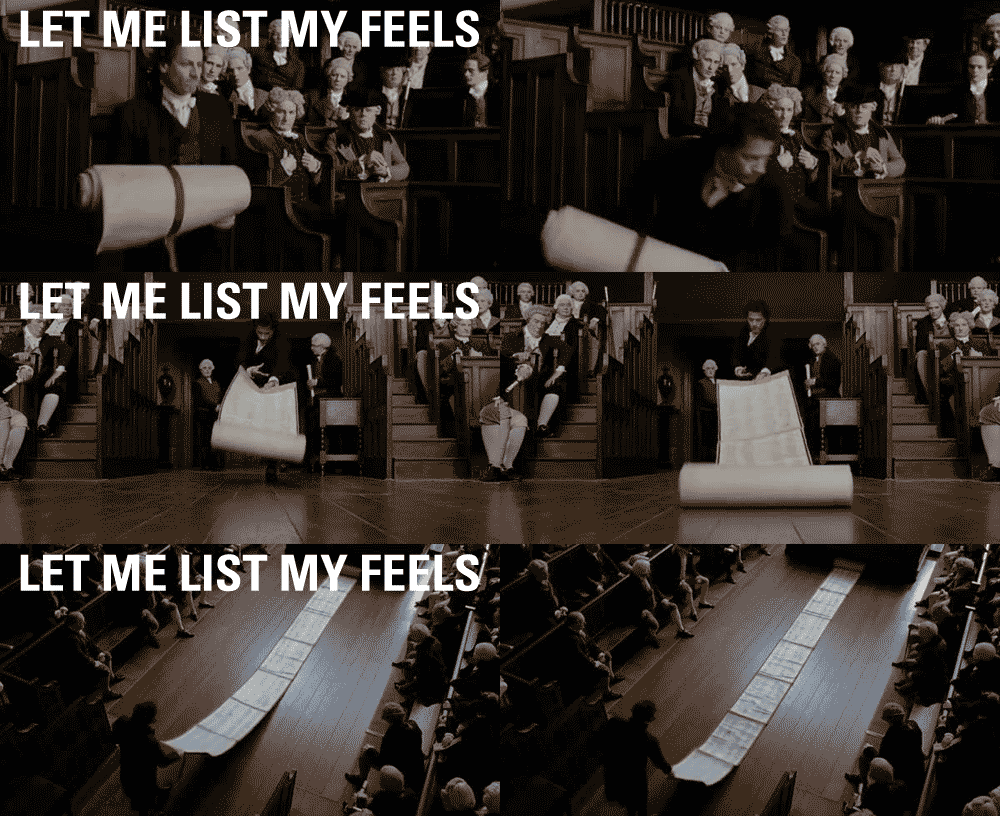
What makes this story work so well rests within Alina and Mal's relationship - and this is a HUGE reason why I adore this book so much.  From the start, it is established that Alina and Mal are all each other really has in this world. They grew up in the orphanage and they left the orphanage together. Alina's power is discovered when Mal's life is threatened.  In terms of love stories in YA fiction, this is honestly one of the best ones there is anywhere.  It feels real and sincere and like it could happen to anyone.  Even as Alina learns about her powers and finds out a lot of really marvelous things about herself - Mal is always that central touchstone in her life.  And it goes both ways, which is absolutely fantastic. In fact, the only reason that there is any conflict between them at all is because Alina’s powers as the Sun Summoner come out into the open and the Grisha pull them apart because that’s just how things are done with the Grisha.  You don't tell the Grisha "No." You just don't.

That kind of dovetails into my next subject - but I also love how Alina has been thrown into this new culture and she doesn’t feel like she fits in. Not because the people are bad or mean to her, necessarily. But because the Grisha are typically found as very young children and they don’t have time to learn any other way to live. In fact, the Grisha characters - particularly Genya - are so multi-faceted and multidimensional. It could have been easy to write all Grisha as narrow-minded and villainous - but they aren’t. They all have distinct personalities, even if they aren’t “on-screen” (as it were) for very long (my favorite of these minor characters is David - read the book and find out).

I also have to talk about the Darkling. Oh my holy crap, the Darkling. I’m not sure how much I want to spoil, since I want my reviews to encourage people to read these books if they haven’t already... oh, what the hell... it’s kind of obvious if you look hard enough. I love how ambiguous his character is at the beginning, though the hints are there that is is just bad news. And his interactions with Alina are so well-paced and so well-written that you do find yourself wanting them to end up together and you’re almost disgusted with yourself afterward (which makes it easy to sympathize with Alina when what happens happens). If heroes are only as good as their villains - then Alina is shaping up to be an incredible hero.

The world-building in this story is absolutely incredible. It’s more or less based around Russian culture which, between watching the Olympics in Sochi and reading a book I found on NetGalley about the Romanov sisters, has become a bit of an interest for me recently. It’s one of those hidden gems in history that gets overlooked - mostly because so much of Russian history was suppressed until comparatively recently (at least, within the course of my own lifetime - I was six when the Soviet Union fell). Western European culture becomes a template for so many fantasy novels - mostly because that’s kind of a literary touchstone for our own culture and that’s what we know the best. But it’s really cool to see other cultures being mined for ideas for fantastical settings (another excellent example is Avatar: The Last Airbender with its Asian and Inuit influences). And not just being mined for ideas, but being mined well.  In the case of Shadow and Bone, there are points where it's hard to tell where the Russian influence ends and the made-up stuff begins because it's just so seamless within the narrative.  And I appreciate that in the world building.  I like that I can say - "Okay, that part's from Russia, that part's made up, that part... um... I'm not sure..."  Then again, I like to get lost in a book's culture and background, so I like that I can just say "This is all Ravka" and be totally okay with it.

(Also, I can totally pinpoint the moment I realized why the book was called Shadow and Bone. I won't give it away, but I was quite pleased with myself when I figured it out. I'll give a hint: it was the same point I understood the cover art).

In conclusion - Shadow and Bone. Go read it NOW! And then go find the second one, Siege and Storm. And then go preorder Ruin and Rising because the ending promises to be one hell of a finale.  And then go cry because this story is so great we still have a few more months to wait.

Thursday, February 13, 2014

Throwback Thursday: The Bad Things Don't Always Spoil the Good - Review of "The Book Thief"

Throwback Thursday makes a triumphant return after a (unintentional) five-month hiatus! For those who missed it (probably a lot of you), I used to have a blog I used solely for reviewing books. But then I started doing more with this blog and decided to consolidate them both. I didn't want to lose all the work I'd done on cj's bookshelf, so I'm slowly migrating them over here. I started last year, but got distracted and kept forgetting to do it. But it's back for your enjoyment!

**Originally posted on cj's bookshelf on June 17, 2011**

Title: The Book Thief
Author: Markus Zusak
Publisher: Knopf Books for Young Readers
Publication Date: December 2005
Reading Level: Age 14 and up

Synopsis: (from Goodreads)
It is 1939. Nazi Germany. The country is holding its breath. Death has never been busier, and will become busier still.

Liesel Meminger is a foster girl living outside of Munich, who scratches out a meager existence for herself by stealing when she encounters something she can’t resist–books. With the help of her accordion-playing foster father, she learns to read and shares her stolen books with her neighbors during bombing raids as well as with the Jewish man hidden in her basement.

In superbly crafted writing that burns with intensity, award-winning author Markus Zusak, author of I Am the Messenger, has given us one of the most enduring stories of our time.

My Review:

Oh, "The Book Thief" - you wonderful, wonderful piece of writing you.

This book first came to my attention through the Mark Reads blog.  All I knew was that it was set in Nazi Germany and there was a girl who stole books.  How the two connected, I hadn't the foggiest idea.  But the themes connected in one of the most beautiful ways I have ever seen.

So many of the stories about the Holocaust and World War II and Nazi Germany focus on the horrible things human beings are capable of doing to other human beings and "The Book Thief" is no exception.  But what this book does so magnificently is telling the story of Germans who - surprise! - didn't actually buy into the Nazi propaganda.  In fact, there were plenty of Germans who were just trying to take care of their families and follow the rules and do what they thought was right.

The best thing about this story is Liesel Meminger, the titular book thief who finds joy and solace in the books she "steals" from various places (though one of those places is the mayor's wife's library - and the mayor's wife purposely leaves the door open for Liesel).  She is just a little girl who plays with her friends and gets into mischief - just like any other kid in any other time period, but her experiences are set up against the backdrop of Nazi Germany.  Her childhood is peppered with flashbacks of her foster father's experience in World War I, scenes of Death (the narrator) picking up souls killed in the war and scenes of the people in Liesel's neighborhood taking cover in a basement during bombings.

My favorite chapter is when Max Vandenburg - a Jewish man Liesel's family is hiding - illustrates a story as a gift to Liesel to thank her for her kindness.  I don't want to go into details about Max's story because it is so lovely and wonderful, but the whole chapter was a brilliant depiction of the story as a whole.

This entire story is an exceptional tale of the very worst of humanity sitting right next to the best of humanity.  It takes all the black and white morality in storytelling and sits it on the bench and lets the grays of real people shine through.  Nothing is ever straightforward, as much as we try to make things good and right.  But that doesn't mean you stop trying to live a good and moral life the best way you know how.